
Stimulated by Horike & Ukezono 2024.[1]
DIY – do-it-yourself
VAS – visual analogue score (for pain intensity in this case)
M-VAS – motion-related VAS (for neck movement-related pain in this case)
NDI-J – neck disability index (Japanese version)
PPT – pressure pain threshold– key to acronyms
This is the second blog on needling necks in as many weeks, but this time there is little or no risk or concern regarding anatomy, despite the fact that the paper involves DIY needling. This is because the needles are only 0.6mm long. Yes, they are the Seirin Pyonex needles of course. I should note that DIY needling to the neck with standard acupuncture needles has been associated with problems in the past – see: AEs in Korea and Japan 2022.
This paper caught my attention because it is something I have done in the past for acute neck pain ie stuck a couple of Pyonex needles on either side of my neck. It was a clinic morning, and I was in a lot of discomfort when turning my head from one side to the other ie when going from looking at my patient to looking at the computer screen. The pain was central, mid to upper cervical, and had come on the day after carrying a bulky and heavy armchair from the garden shed to the kitchen. I had rested some of the weight of the chair on my head and neck during the process.
By the end of the morning clinic, I found I was turning my head entirely painlessly, but I did not notice exactly when the pain disappeared. Of course, it may have disappeared entirely as a result of the natural history of the condition rather than anything to do with the needles embedded in my neck.
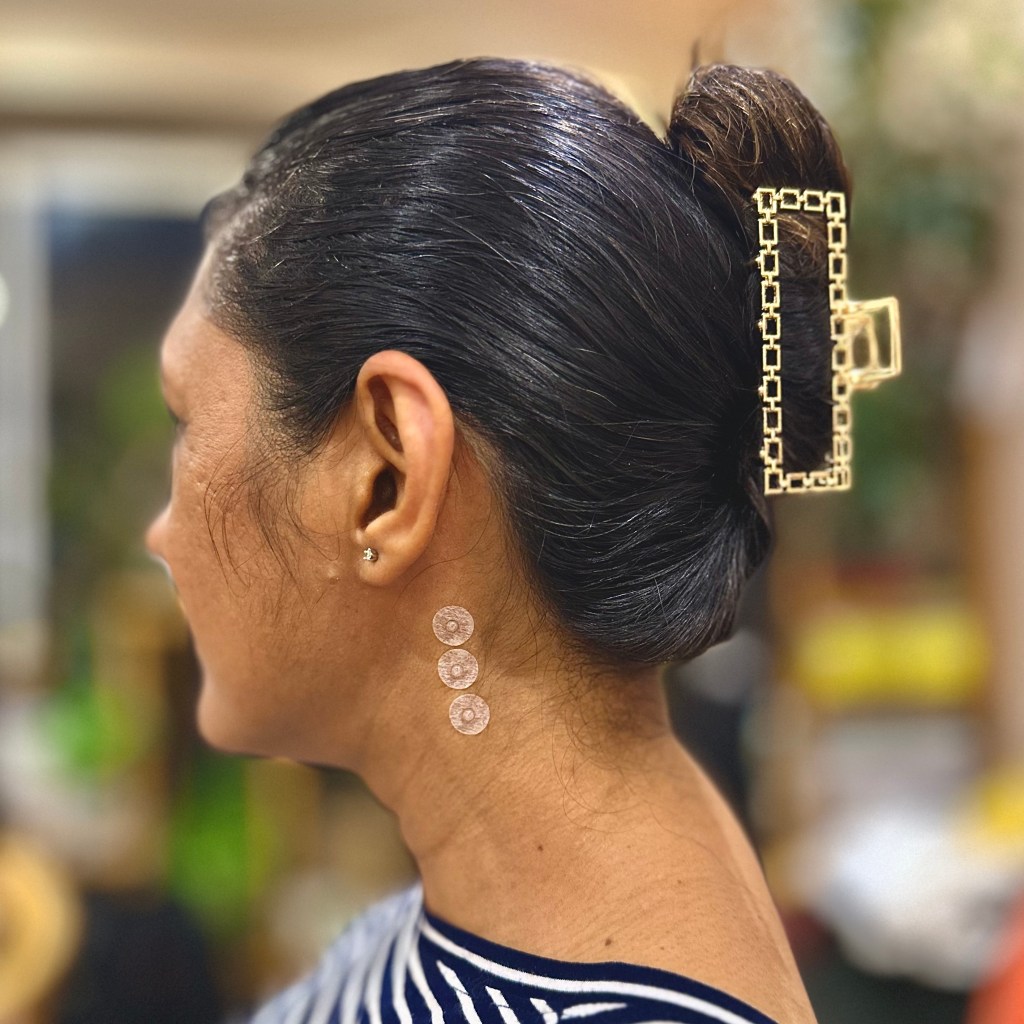
In this study, 50 patients with chronic neck pain were randomised to 3 weekly applications of press needles or placebo devices, which were retained for 7 days each time. Pyonex press needles come in 5 sizes and colours: orange (0.3×0.11mm); yellow (0.6×0.15mm); green (0.9×0.17mm); blue (1.2×0.20mm); and pink (1.5×0.20mm). The needles are embedded in a small plastic nodule, which is in the centre of, and intimately attached to, a circular adhesive plaster.
Prior to these needles being developed, the BMAS did not recommend the use of press needles because they were so easy to lose in the community. The Pyonex needles changed that because they are very easy to see, so even if they fall out, it is easy to retrieve them.
Sometime after these needles were introduced, a ‘placebo’ version was developed which looked identical but did not have a needle. You can argue that the plastic nodule still allows some acupressure, which is true; however, penetrating needling comes with potential risks, so measuring the difference between needling and acupressure is still important.
In this study the yellow size was used in the active group and the placebo version was used in the control. Up to 4 needles were applied to tender points on the neck as far down as the scapula. An acupuncturist instructed the patients for the first two applications ie week 1 and week 2, and then the patients applied the points by themselves on week 3.
The primary outcome was pain intensity on VAS. This was measured at 4 time points: baseline (A0); after the first session (A1); at the end of the last session (A2); and 1 week after the last session (A3). Secondary outcomes included motion-related VAS (M-VAS), NDI-J score, and PPT of upper trapezius (at GB21) and levator scapulae (at SI14). I should note that the PPT at SI14 is likely to measure the pain threshold in mid trapezius fibres rather than levator scapulae, but that doesn’t really matter here.
VAS pain reduced in both groups and the active group tended to be better off ie had greater pain reduction, but the difference did not reach statistical significance at any time point. M-VAS pain reduction (as I had experienced that day in clinic) did reach statistical significance in favour of the real needles at A2 ie immediately after the 3 weeks of self-treatment. The difference was no longer significant at A3 (1 week later). There were no differences in PPT and only a trend in favour of real needles in the NDI-J.
The authors did some fancy statistical modelling (covariance structure analysis) and concluded that the needles did have a significant effect on pain reduction (although this was not the primary outcome). They also found that the reduction of pain with press needle use was related to baseline severity, and that age and computer work also had an influence on the size of the effect.
Personally, I never use anything smaller than the pink needles because I cannot feel anything with the smaller ones, so I would be interested to see if the effects were improved with this slightly bigger dose.
I am not at all surprised that the effect measured on M-VAS was short-lived since the stimulus here is in the skin, and skin sensation adapts much more rapidly than the sensory effects of deep somatic stimulation (eg intense exercise or muscle needling).
Reference
1 Horike K, Ukezono M. Efficacy of chronic neck pain self-treatment using press needles: a randomized controlled clinical trial. Front Pain Res. 2024;5:1301665. doi:10.3389/fpain.2024.1301665
 The BMAS Blog
You must be logged in to post a comment.