
Inspired by Huang et al 2024.[1]
IF – impact factor
APC – article publishing charge
NHIRD – national health insurance database (Taiwan)
LGTD2000 – longitudinal generational tracking database from 2000
NSAIDs – non-steroidal anti-inflammatory drugs
aHR – adjusted hazard ratio– key to acronyms
This is another large retrospective cohort study from Taiwan published in the Journal of Traditional and Complementary Medicine. I highlighted a paper from the same group published in the same journal on a related subject in July last year: Acupuncture and dementia risk in insomnia 2023.[2] So, we have swapped out dementia risk for stroke risk – both very import conditions in public health terms. I highlighted the same group in 2022 as well Acupuncture and dementia risk in migraine 2022.[3]
I mentioned some details about the journal in the previous blog, and I see that the IF has fallen a little from 4.5 to 3.3, still a very respectable number and helped by being open access with no APC! The journal is based in Taiwan and is sponsored and co-owned by the Ministry of Health and Welfare.
This is from the journal website:
There are no publication charges for open access for the author. Center for Food and Biomolecules, National Taiwan University will pay to make the article open access.
Nice!
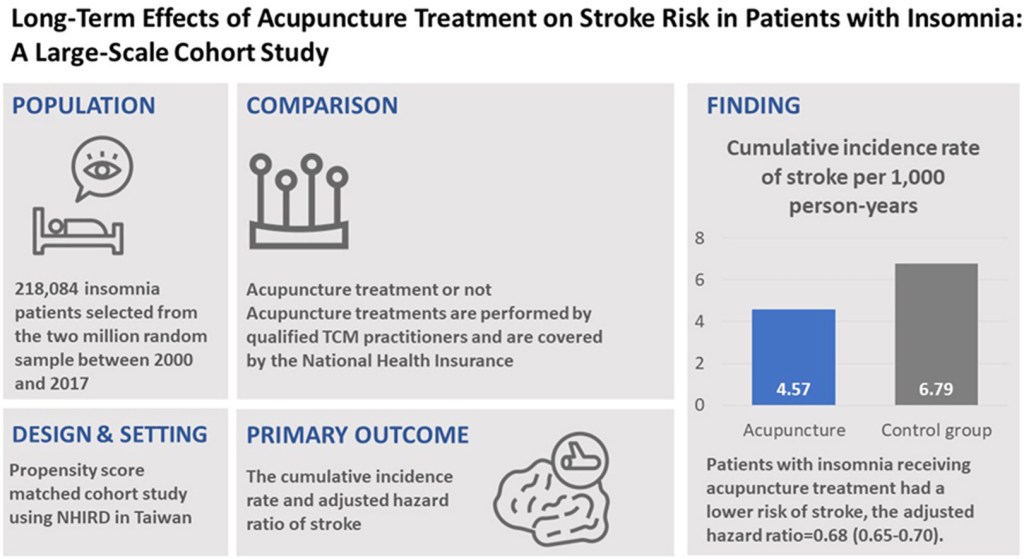
This study used the NHIRD from Taiwan, or more specifically, the LGTD2000. They found 575 434 patients with either insomnia or sleep apnoea between 2000 and 2017, which is more than 25% of the sample, since the LGTD2000 includes a random sample of 2 000 118 people from the entire NHIRD (~23 million).
Patients who had received 6 or more acupuncture sessions (n=151 576) were then matched with a similar group who had not received acupuncture (n=195 439). After propensity score matching by insomnia diagnosis year, index year, sex, age, income, urbanisation, comorbidities, and related medication, each group was reduced to 108 678 – still very big samples to compare.
64% of the cohorts were female and over 60% were listed as having taken benzodiazepines. A whopping 80% plus were listed as having taken NSAIDs, and just under 20% had taken aspirin. I mention these, because they were all associated with a significant change in the risk of stroke – increased, decreased, and increased respectively.
Acupuncture use (more than 6 sessions following diagnosis) was associated with a greater than 33% reduced risk of stroke (aHR 0.66). This risk reduction applied in all circumstances, whether demographic, comorbidities, or medications.
Of particular interest is that the risk appeared to reduce with greater use of acupuncture, with the lowest risk (aHR 0.58) associated with 30 or more sessions.
References
1 Huang C-H, Lin S-K, Lin H-J, et al. Clinical effects of acupuncture treatment for prevention of insomnia-induced stroke: A large-scale cohort study. J Tradit Complement Med. 2024;S2225411024000865. doi: 10.1016/j.jtcme.2024.07.003
2 Huang C-H, Lin S-K, Lin M-C, et al. Acupuncture is associated with reduced dementia risk in patients with insomnia: A propensity-score-matched cohort study of real-world data. J Tradit Complement Med. 2023;13:297–305. doi: 10.1016/j.jtcme.2023.02.003
3 Huang C-H, Lin M-C, Chou I-C, et al. Acupuncture Treatment is Associated with Reduced Dementia Risk in Patients with Migraine: A Propensity-Score-Matched Cohort Study of Real-World Data. Neuropsychiatr Dis Treat. 2022;18:1895–906. doi: 10.2147/NDT.S372076
 The BMAS Blog
You must be logged in to post a comment.