
Stimulated by Kim et al 2025.[1]
SCI – spinal cord injury
– key to acronym
This paper was published in late August this year in the Korean Journal of Neurotrauma, but it has only just come up on my PubMed searches in the last week or so.
It is not really extensive enough to devote to an entire blog and webinar, hence 2 blogs this week. I have separated them for ease of future reference.
The link should be obvious… needling 50mm to 90mm from GB20 to the back of the pharynx, as mentioned in Acupuncture for PSD 3 2025, and presumed direct needling in the spinal cord as reported in the two cases in this paper.
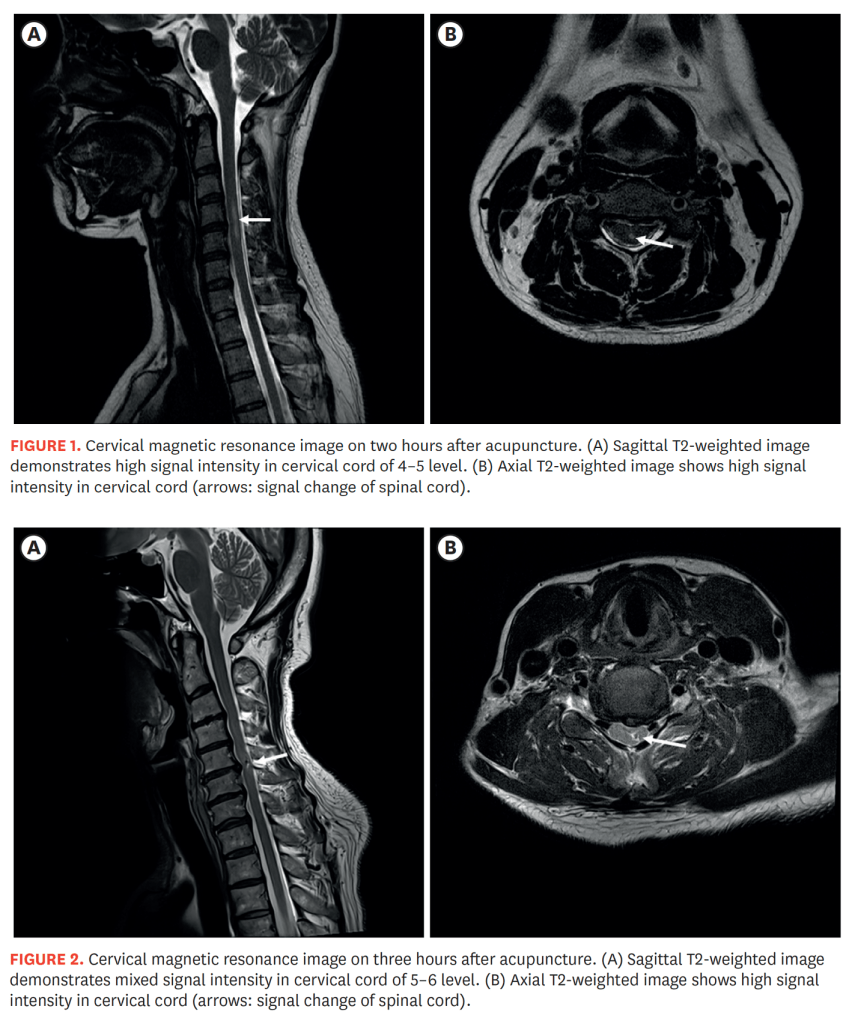
Both cases involve young to middle-aged women (35 and 48 years old) who presented with neurological signs affecting the left upper limb within 2 hours of an acupuncture treatment that included needling in the mid-cervical region.
MR imaging (T2 weighted) demonstrated high signal intensity within the cervical spinal cord in both cases.
There are limited details of the acupuncture treatment, but the rapid onset of neurological signs following treatment combined with the imaging appearances, strongly suggest direct penetration of the spinal cord by an acupuncture needle in both cases.
In the first case, mild motor weakness persisted at the 2-year follow-up, and paraesthesia reduced in intensity from 8 (NRS 0-10) to 4 over the same period. In the second case, moderate motor weakness of the left upper limb improved at 2 months; however, painful paraesthesia continued to require the use of medication.
Both cases were treated acutely with dexamethasone, amitriptyline, gabapentin, and paracetamol.
From here I should make a link back to other closely related blog posts (see AEs in Korea and Japan 2022 and Spinal epidural haematomas 2020) since the Adverse events category on the blog now has 57 posts.
References
1 Kim MS. Cervical Spinal Cord Injury Due to Direct Needle Damage During Acupuncture. Korean J Neurotrauma. 2025;21:323–8. doi: 10.13004/kjnt.2025.21.e27
 The BMAS Blog
You must be logged in to post a comment.