
Stimulated by Mousley et al 2025.[1]
IF – impact factor
MR – magnetic resonance
DTI – diffusion tensor imaging
3D – three dimensional
2D – two dimensional
GMV – grey matter volume
WMV – white matter volume
TCV – total cerebral volume– key to acronyms
I heard a news item on this research on BBC Radio 4 at the beginning of last week (Tuesday 25th November to be precise). The sound bite suggested that the research had identified 4 key turning points in brain structure over the human lifespan and these were age 9, 32, 66, and 83. I think I heard a comment that the adolescent phase was between 9 and 32.
This caught my attention because I had read about changes in functional activity (specifically the position of the node of generation of slow waves) in sleeping brains that continued well into the late 20’s, and because of my personal experience of subjective (cognitive~emotional) development (the degree to which I thought I ‘knew everything’ in the way that adolescents often seem to ‘know everything’), which seemed to change in my early thirties.
Over the rest of the week, I asked people if they had heard this news, and nobody seemed to have picked up on it. So, I decided to look up the paper, which was published in the journal Nature Communications (IF 15.7). It is a pretty complex paper, and there is nothing about acupuncture in it, but it seemed important to me, and after all, we all treat humans across the lifespan, so knowing a little about how the brain changes might be useful.
The team doing the research was based in Cambridge and they used 9 different datasets of diffusion MR imaging covering different stages of the entire human lifespan. In total, over 4 thousand individual scans were used.
DTI is a way of assessing white matter tracts, including both orientation and connectivity, as well as integrity. I last discussed DTI in the blog titled Bell’s palsy and DTI 2023, which contains links to all the prior mentions of the technique, including the first time I encountered fractional anisotropy (one particular metric in DTI) in 2018 (see Rewiring the brain with acupuncture).
DTI allows 3D reconstruction of white-matter pathways (tractography), which when applied to the whole brain creates mathematically complex, multidimensional patterns of connectivity. The awake human consciousness (devoid of psychedelics) can generally only cope with 2 or 3 dimensions, so the team used something called manifold learning to simplify these patterns and look for trends. A manifold is a complex high-dimensional shape like a crumpled piece of paper (thanks to ChatGPT5.1 for the analogy) and manifold learning allows this crumpled sheet to be spread out more simply into a flat 2D sheet or a simplified 3D shape so we humans can more easily appreciate the complex topology of our own brains (ironic isn’t it).
Various metrics were assessed using dedicated software. Some of the terms seem easier to understand than others. For example, global efficiency measures how well a network is connected by short (hence fast) path lengths, but small-worldness and centrality are terms that are not so easy to intuit.
Small-worldness describes a special kind of network that is both highly efficient and highly specialised. It is a combination of strong local clusters and short global paths.
Centrality measures a node’s importance to the network often based on inclusion in key paths. It is divided into betweenness centrality (the fraction of shortest path lengths that pass through the node – ie how often the node lies on the shortest route between 2 other nodes) and subgraph centrality (the weighted sum of all close walks starting and ending at the node – ie how many closed loops or repeating communication paths go through the node).
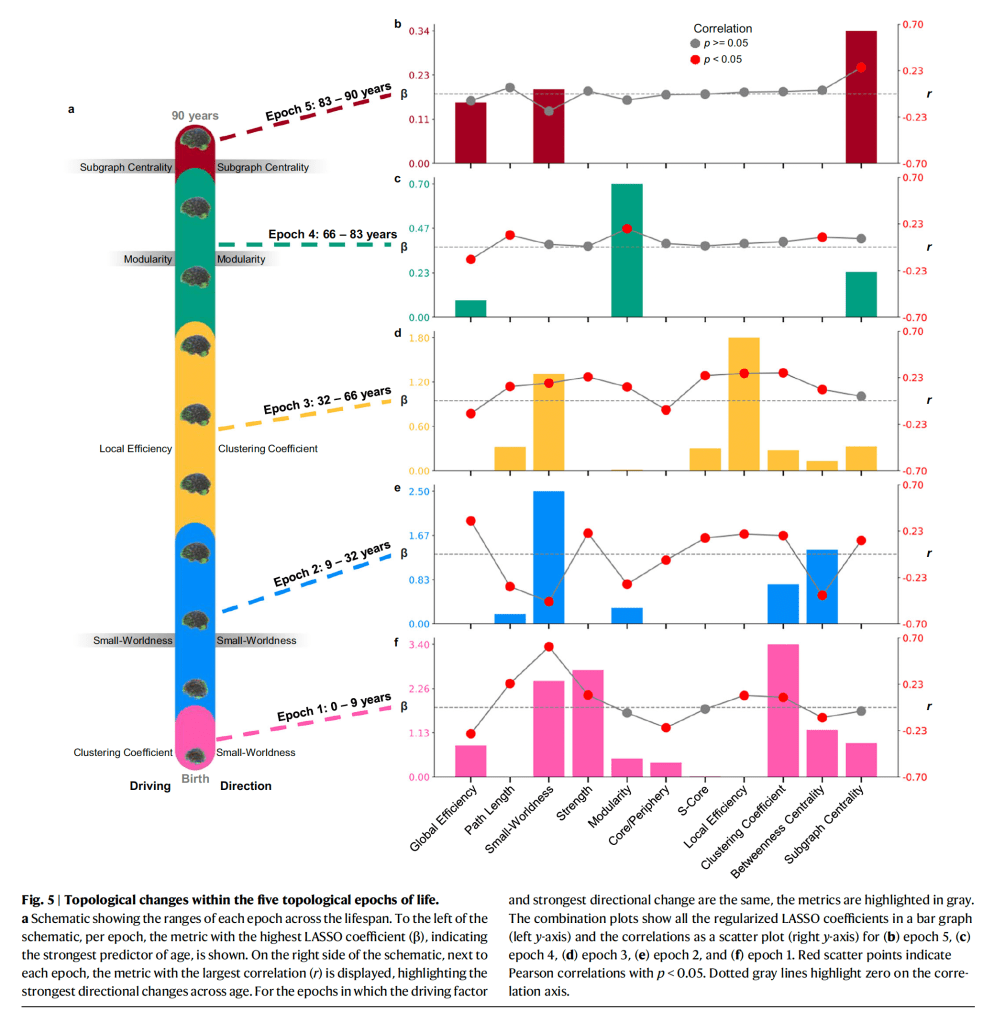
The lifespan was divided into 5 unequal epochs spanning the turning point ages mentioned above. The first, from 0 to 9 (infancy to childhood) was characterised by decreasing global integration, increased local segregation and stable centrality. The brain at birth is highly connected and therefore highly receptive to new experiences. As it develops, the unused connections can be pruned to enhance efficiently, hence a decrease in global connectivity and an increase in segregation. Small-worldness increases during this period and is the metric most correlated with age.
Epoch 2, from 9 to 32, is characterised as ‘adolescence’, and dominated in the analysis by decreasing small-worldness. This is the only period where globally efficiency increases, and at the same time characteristic path length, small-worldness, modularity, and betweenness centrality all decrease.
Epoch 3, from 32 to 66, is the adult period, and the drama of the preceding epochs is over. This period is dominated by local efficiency (the extent to which neighbouring nodes are connected by short paths) and the clustering coefficient (the extent to which neighbouring connected nodes are also connected to eachother), although the scene is pretty flat in terms of the correlations of these metrics with age. Indeed, it stays flat for this and the subsequent epochs.
Epoch 4, from 66 to 83 (early aging), is dominated (albeit minor domination) by modularity (how well a network can be divided into non-overlapping, highly intra-connected node groups). Global efficiency takes a bit of a downturn, but it is not as dramatic as in the final epoch.
In epoch 5, from 83 to 90 (late aging), the sample size was smallest (n=93 compared with 406, 1092, 1728, and 733 for the previous epochs in reverse order), so the analysis, in simple terms, is a bit fuzzier. The one metric that correlates with age is subgraph centrality, which increases, but this was only significant in 10 of 86 regions assessed, so probably best not to read too much into that.
The same team (second and last author) were involved in an even larger project involving MR scans from over 100k individuals. This was published in the journal Nature (IF 48.5) in 2022.[2] This charts metrics such as grey matter volume (GMV), white matter volume (WMV), total cerebral volume (TCV), rather than white matter connections as in the current paper. It is interesting to note that GMV peaks at age 5.9, WMV at age 28.7, and TCV at age 11 to 12. I’ll show you all the fancy graphics from both papers on the Wednesday webinar.
References
1 Mousley A, Bethlehem RAI, Yeh F-C, et al. Topological turning points across the human lifespan. Nat Commun. 2025;16:10055. doi: 10.1038/s41467-025-65974-8
2 Bethlehem RAI, Seidlitz J, White SR, et al. Brain charts for the human lifespan. Nature. 2022;604:525–33. doi: 10.1038/s41586-022-04554-y
 The BMAS Blog
You must be logged in to post a comment.