
Stimulated by Zhang et al 2025.[1]
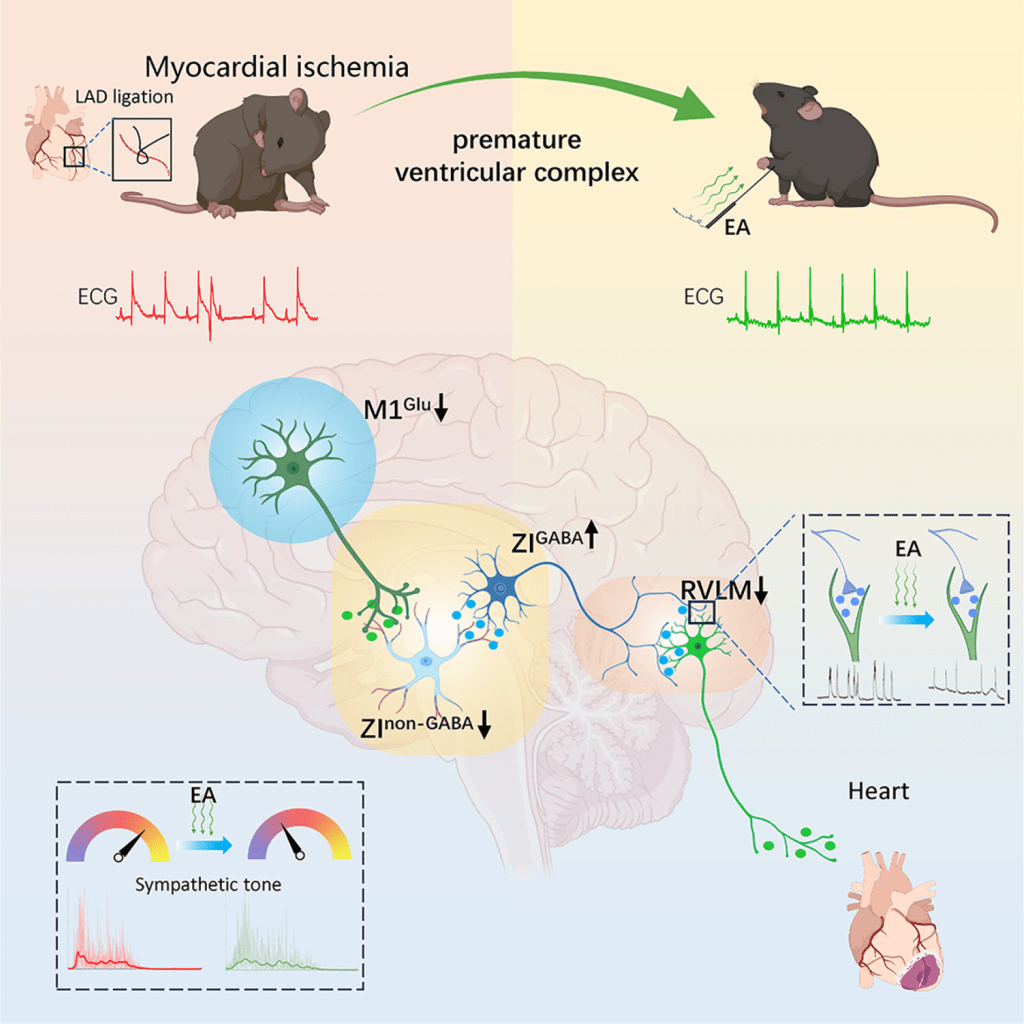
EA – electroacupuncture
PVCs – premature ventricular complexes
MI – myocardial infarction
IF – impact factor
VF – ventricular fibrillation
ECG – electrocardiogram
AAV – adeno-associated virus
DREADD – designer receptor exclusively activated by designer drug
M1L5 – lamina 5 of the primary motor cortex
RVLM – rostral ventrolateral medulla
ZI – zona incerta– key to acronyms
This is another EA paper (the second ever) in the journal Cell Reports (IF 6.9) and it comes from Hefei in China. Hefei is the capital of Anhui province and lies ~461km inland (west) from Shanghai. Nanjing is on the way from Shanghai to Hefei but lies closer at ~174km. In terms of latitude, Hefei is roughly halfway between them, with Nanjing being the most northerly of these 3 cities, which is potentially confusing in this limited view as the name means southern capital.
The first paper on EA in Cell Reports was highlighted here earlier this month – see Prenatal-EA for MIA 2025.[2] The two groups are located ~650km apart and I can see no repeated names or affiliations on the author lists, so I guess there is no link.
Whilst there have now only been 2 papers on EA (acupuncture) in the journal Cell Reports, a sister journal Neuron (IF 15) has already published some key papers in the field that have been highlighted here – see EA and GI function 2025,[3] and ST36 vs ST25 EA in sepsis.[4]
This paper takes a mechanistic view of an entirely new topic – EA suppression of PVCs. I have mentioned PVCs before here, but not by this name or acronym – see Spinal epidural haematomas 2020, where a detour in the narrative referred to ventricular ectopic beats increasing prior to VF in a 37-year-old man, just post-MI, to whom I gave a thrombolytic.
My experience from that era (the late 80’s) was that frequent PVCs on an ECG trace in CCU meant that we (the handful of staff on duty) would soon be in a race for who was first to grasp the paddles.
But the infamous CAST trial published the following year in the New England Journal of Medicine (current IF 78.5) gave the cardiology community a reason to pause.[5] This showed that using antiarrhythmics (encainide or flecainide) to suppress asymptomatic or mildly symptomatic ventricular arrhythmias (6 or more PVCs per hour) resulted in a >3 times increased risk of death despite suppressing PVCs.
In this series of experiments in a post-MI murine model, EA via a pair of needles at HT7 (2Hz, 0.5mA, 20 min, 50μs) suppressed PVCs and increased survival (~50%). Sophisticated (but increasingly routine) methods for pinpointing the relevant neural activity and connections that mediated the beneficial effects were used, including transsynaptic viral tracers, c-fos expression, stereotactic injection of AAVs, optogenetic neural activation and of course a DREADD.
In brief, this team have identified a neural circuit that involves lamina 5 of the primary motor cortex (M1L5) and the RVLM via the zona incerta (ZI). In simple terms, this circuit mediates increased sympathetic activation of the myocardium post-MI and low intensity EA at HT7 suppresses the activation at M1L5.
So, both EA and flecainide et al can suppress PVCs post-MI, but the former increases survival in murine models, whereas the latter increases mortality in humans. This difference must certainly be related to mechanisms. Whilst flecainide can have a powerful direct effect on depolarisation in cardiac myocytes (via blockade of fast sodium channels), EA clearly has a more subtle indirect effect on the upstream neural circuits responsible for driving autonomic balance in the post-MI heart.
Come to the webinar this Tuesday to see all the lovely (but rather complex) summary diagrams in the paper and hear me trying to explain the methods used.
References
1 Zhang F, Wang Q-Y, Wei N-X, et al. Electroacupuncture suppresses premature ventricular complexes occurring post-myocardial infarction through corticothalamic circuit. Cell Rep. 2025;45:116734. doi: 10.1016/j.celrep.2025.116734
2 Zhang Z, Lin W, Yan J, et al. Prenatal electroacupuncture modulates maternal-fetal immune activation via a brain-to-splenic signal. Cell Rep. 2025;44:116576. doi: 10.1016/j.celrep.2025.116576
3 Dong S, Zhao L, Liu J, et al. Neuroanatomical organization of electroacupuncture in modulating gastric function in mice and humans. Neuron. 2025;S0896-6273(25)00504-5. doi: 10.1016/j.neuron.2025.06.023
4 Liu S, Wang Z-F, Su Y-S, et al. Somatotopic Organization and Intensity Dependence in Driving Distinct NPY-Expressing Sympathetic Pathways by Electroacupuncture. Neuron. 2020;108:436-450.e7. doi: 10.1016/j.neuron.2020.07.015
5 Cardiac Arrhythmia Suppression Trial (CAST) Investigators. Preliminary report: effect of encainide and flecainide on mortality in a randomized trial of arrhythmia suppression after myocardial infarction. N Engl J Med. 1989;321:406–12. doi: 10.1056/NEJM198908103210629
 The BMAS Blog
You must be logged in to post a comment.