

Stimulated by Wei et al 2026.[1]
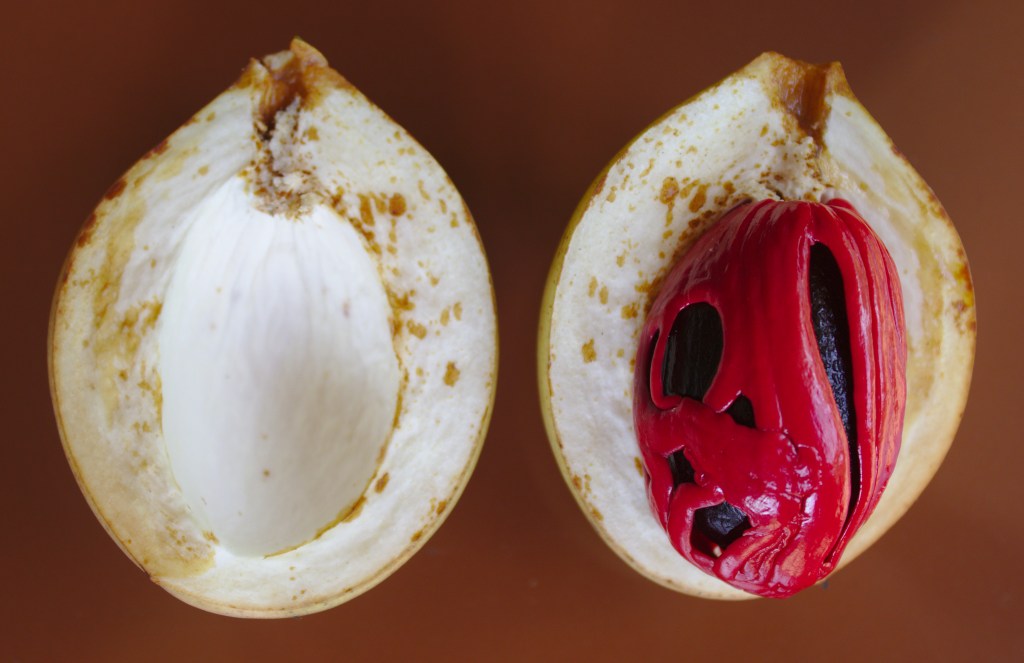
This is an image of the fruit of Myristica fragrans (nutmeg) split open to show the seed with the surrounding aril (also known as mace). I cannot help thinking it looks a bit like a heart.
EA – electroacupuncture
SF-NR – slow flow / no-reflow (refers to inadequate myocardial perfusion post-PCI)
PCI – percutaneous coronary intervention
IF – impact factor
AMI – acute myocardial infarction
TIMI – thrombolysis in myocardial infarction
CTFC – corrected TIMI frame count
NRS – numerical rating scale
VAS – visual analogue scale
MACCE – major adverse cardiovascular or cerebrovascular event– key to acronyms
This is a rather unique pilot study (n=60) published in the journal Frontiers in Cardiovascular Medicine (IF 2.9). I had not come across SF-NR before seeing the title of this paper on PubMed, so I think it is a first in terms of clinical research (on humans). There are, of course, numerous laboratory studies, principally from China, on animal models of such things as myocardial ischaemia reperfusion injury and the effect of acupuncture in mitigating it (currently 25 on Pubmed for the search myocardial ischaemia reperfusion injury AND acup* [ti]).
Most of the authors of this paper are from Shanghai, but there is one name from Addenbrookes. Professor Thomas Krieg is professor of Experimental Cardiovascular Medicine at the University of Cambridge, and an honorary consultant physician at Addenbrookes Hospital. He has a lab named after him – The Krieg Lab. According to the paper, he was responsible for the formal analysis amongst other things.
SF-NR complicates up to 44% of PCI procedures post-AMI. SF-NR is essentially inadequate myocardial perfusion despite successful opening of a restriction in an epicardial coronary artery. It is caused by a variety of mechanisms, including distal embolization (of plaque debris or thrombus), ischaemia reperfusion injury, microvascular spasm, inflammation affecting the endothelium of small vessels. EA could conceivably have some effect on the latter three of these.
60 patients undergoing PCI for AMI were recruited and randomised to EA during PCI or PCI alone. EA was performed in the left forearm between PC4 and PC6 throughout the procedure. A 20Hz continuous frequency was applied at an intensity tolerated by the patient.
The primary outcome was the incidence of SF-NR, where SF-NR was defined by the TIMI flow grade and the corrected TIMI frame count (CTFC). The former has 4 grades from 0 to 3, where 0 is complete occlusion (of the coronary artery) and 3 is normal flow (the same as in an unaffected vessel). TIMI 1 is where there is some penetration of contrast into and past the lesion but without opacification of the distal bed. TIMI 0 and 1 are essentially ‘no reflow’ situations leaving TIMI 2 as ‘slow flow’, where the distal bed opacifies, but not as quickly as in a normal vessel. Differentiating TIMI 2 from TIMI 3 is clearly critical in terms of the outcome of this and no doubt other similar studies on PCI. This is where CTFC comes in. To do this you go back and actually count the frames of the recorded video (at 30 frames per second) from first opacification of the main vessel to complete clearance of contrast in the distal bed. 20 frames would be TIMI 3 (normal) and 25 to 40 would fall into the slow flow TIMI 2 range. In this paper they defined slow flow TIMI 2 as >27 frames and no reflow TIMI 0 or 1 as >40 frames.
2 of the 30 patients in the EA group were categorised as SF-NR compared with 6 or 8 in the control. The paper states 8, which gives a significant result, but the supplemental Table 1 includes only 6 in the SF-NR category (TIMI 0-2). If it is 6 rather than 8, it may not be a significant result. I have asked one of the corresponding authors to clarify the numbers but not yet had a reply. I was going to be cheeky and ask Professor Krieg, but he sensibly hides his email.
Whether statistically significant or not, as a pilot study, it will hopefully allow planning for further larger scale research in this setting.
Secondary outcomes were numerous, which is typical of a pilot study. Only a few showed significant differences between groups and there was no correction for multiple statistical testing. There were highly significant differences in pain NRS and anxiety VAS (VAS-A) during PCI and at 12 hours post-PCI. Whilst these probably do represent real differences, they are subjective outcomes and the patients were not blind to treatment group allocation.
Of the objective secondary outcome measures, just a few of the inflammatory biomarkers showed a difference at 12 hours but not at 72 hours post-PCI. The p values were only marginally under 0.05, so given that there are 20 others, these ones are of dubious significance at this stage.
30-day MACCEs were 5 in the EA group and 11 in the control. This is a substantial reduction, but this outcome was not statistically significant, and the trial was not adequately powered for this outcome of course. MACE with one C has come up on the blog previously – see Acupuncture and MACE.
Before I sign off, something called TCM Scores were reported on (they were not significantly different between groups) but do not appear at any point in the methods.
References
1 Wei X, Peng Y, Wang K, et al. Electroacupuncture for slow flow/no-reflow in patients with acute myocardial infarction undergoing percutaneous coronary intervention: a pilot randomized controlled trial. Front Cardiovasc Med. 2026;13:1756414. doi: 10.3389/fcvm.2026.1756414


You must be logged in to post a comment.