

Stimulated by Zheng et al 2026.[1]
TEAS – transcutaneous electrical acupuncture point stimulation
PONV – post-operative nausea and vomiting
IF – impact factor
RCT – randomised controlled trial
IV – intravenous
GA – general anaesthesia
NRS – numerical rating scale
TENS – transcutaneous electrical nerve stimulation
5-HT – 5-hydroxy-tryptamine aka serotonin
NNT – number needed to treat
BBs – Bandolier boys– key to acronyms
This paper was published earlier this year in JAMA Surgery (IF 14.9). I first saw it online at the end of January and it reached an issue in March.
It is a multicentre sham controlled double dummy RCT (n=232) comparing TEAS at PC6 with 10mg of IV metoclopramide in female patients undergoing thyroidectomy or anterior cervical surgery under GA who later developed moderate to severe PONV (NRS 4 or more).
I first came across a device for applying electrical stimulation (TENS) in the area of PC6 more than 2 decades ago. It was called ReliefBand and there are 12 citations mentioning this device dated from 1999 to 2015 on PubMed.
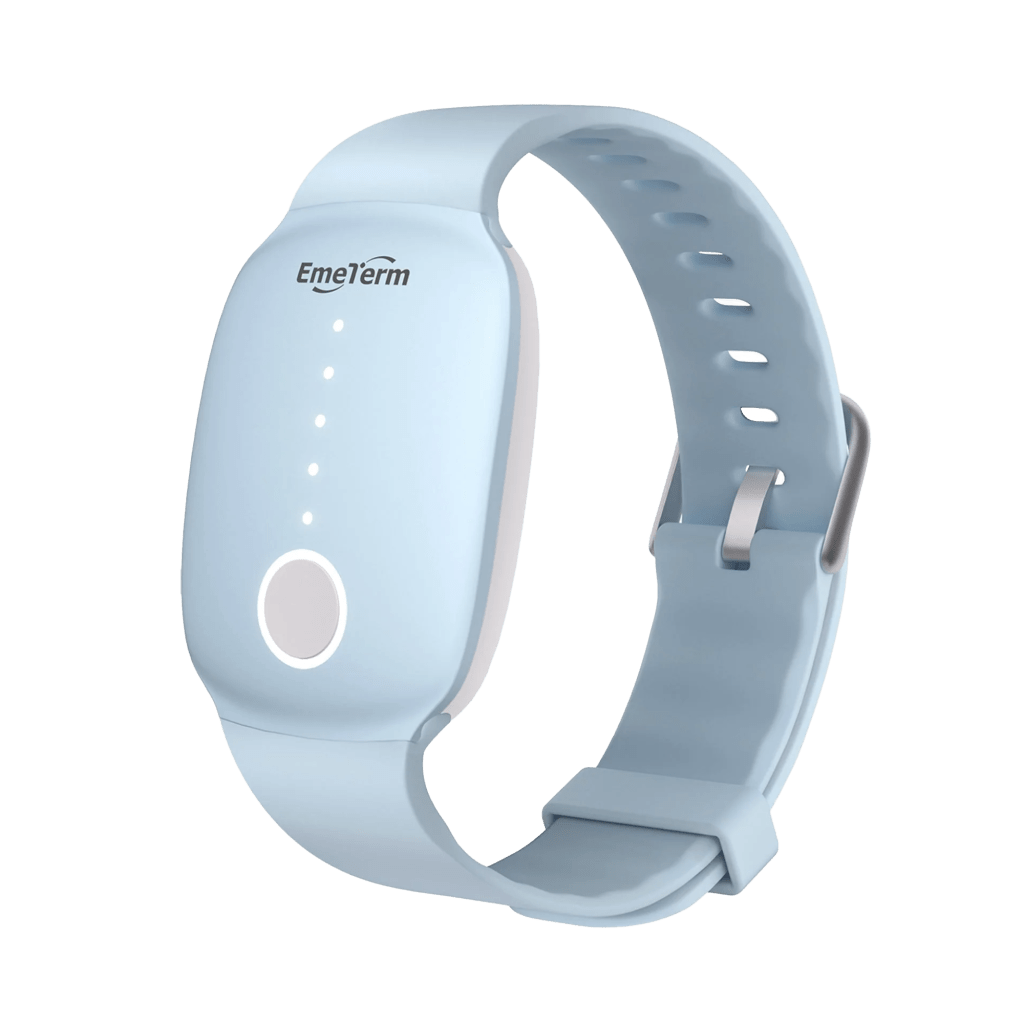
This trial uses an updated version called EmeTerm, for which there are currently 4 citations on Pubmed – 2 trials,[1,2] 1 letter,[3] and 1 protocol.[4] EmeTerm has its own website here, and is distributed by the company WAT Medical Enterprise Ltd. This company was first registered in British Columbia, Canada in 2017.
PONV is relatively common after thyroidectomy. In the absence of prophylaxis PONV ranges from 22–52% after induction of GA, and this increases to 60–84% after thyroidectomy.[5] It is thought to be related to intense vagal stimulation through surgical handling of the neck, plus the fact that the population undergoing the procedure are mostly young to middle-aged women, in whom the risk of PONV is high.
I was surprised to find that the drug at the top of the list for prevention of PONV following thyroidectomy is not actually an antiemetic at all, at least that is not what it was designed for, it is the hypnotic and anaesthetic drug propofol.[5] Tropisetron is next on the list, followed by a bunch of other -setron drugs (the 5-HT3 receptor antagonists). Towards the bottom of the list is dexamethasone and metoclopramide.
In this trial, all the patients had propofol, dolasetron, and dexamethasone as part of the standard GA protocol, so those eligible to join the trial already had moderate to severe breakthrough PONV by definition. The baseline median NRS PONV severity was 7 out of 10.
The primary outcome was the 2-hour remission rate as defined by an NRS PONV of 3 or less. This remission rate was 77.6% in the TEAS device group and 55.2% in the IV metoclopramide group (p<0.001). The NNT for this outcome was 4.5, which is the same as that quoted by the Bandolier boys (BBs) for acupuncture in PONV decades ago – see The problem with sham for a mention of the BBs. They were grudgingly positive about the size of the NNT back then, which was the only vaguely positive thing they ever said about acupuncture.
The 24-hour relapse rate was also highly significantly different, with 11 in the TEAS group and 36 in the IV metoclopramide group (p<0.001).
There was a slightly messy cross-over part to the trial, and the TEAS again outperformed the IV metoclopramide.
This all sounds very positive, but there are some limitations to consider. First and foremost, the device costs considerably more than a dose of metoclopramide. The author of an invited commentary suggested this could be a 100 to 200 times difference in cost.[6] This clearly could have implications regarding cost-effectiveness, although to be fair, this was not a cost-effectiveness analysis.
In terms of methodology, we have a solid double dummy approach, but this is weakened by the combination of potential unblinding via the electrical stimulation from the real device combined with a subjective assessment of the primary outcome by the patient.
I am sure WAT Medical would love to have big sales to formal healthcare institutions; however, their websites appear to be directed more at the general public with several versions available, each directed at a different group. These versions are called EmeTerm… Smart, Explore Active (salt water resistant), Explore (waterproof), Fashion, and Kids. They also have a device that looks the same but is called eCoffee, and it looks as though it gives you a buzz to keep you awake. They even have a version that takes the place of your Apple watch strap, so you can wear them both on the same wrist at the same time.
They also have one for weight loss called ObeEnd… I guess the name ObiWan was taken years ago.
References
1 Zheng D-Y, Ding P, Gong M, et al. Transcutaneous Electrical Acupoint Stimulation vs Metoclopramide for Moderate to Severe Postoperative Nausea and Vomiting: A Randomized Clinical Trial. JAMA Surg. 2026;161:268–73. doi: 10.1001/jamasurg.2025.6394
2 Yang Y, Wang C, Cao G, et al. Risk of Postoperative Nausea and Vomiting After Total Hip or Knee Arthroplasty Under Spinal Anesthesia: Randomized Trial Comparing Conventional Antiemetics with or without the EmeTerm Bracelet. J Bone Joint Surg Am. 2025;107:1063–72. doi: 10.2106/JBJS.24.00773
3 Bargar WL. Rigorous Control in Clinical Research: Evaluating the EmeTerm Bracelet for PONV Prevention: Commentary on an article by Yidan Yang, MMSc, et al.: “Risk of Postoperative Nausea and Vomiting After Total Hip or Knee Arthroplasty Under Spinal Anesthesia: Randomized Trial Comparing Conventional Antiemetics with or without the EmeTerm Bracelet.” J Bone Joint Surg Am. 2025;107:e53. doi: 10.2106/JBJS.25.00014
4 Ding P, Zheng D-Y, Zhu H-W, et al. Efficacy of wearable transcutaneous electrical acupoint stimulation bracelet on moderate-to-severe postoperative nausea and vomiting in patients after general anesthesia: a study protocol for a multicenter randomized controlled trial. Trials. 2024;25:805. doi: 10.1186/s13063-024-08650-4
5 Cho YJ, Choi GJ, Ahn EJ, et al. Pharmacologic interventions for postoperative nausea and vomiting after thyroidectomy: A systematic review and network meta-analysis. PloS One. 2021;16:e0243865. doi: 10.1371/journal.pone.0243865
6 Aalami O. Wearable Antiemetics. JAMA Surg. 2026;161:274. doi: 10.1001/jamasurg.2025.6403


You must be logged in to post a comment.