

Stimulated by Chen et al 2026.[1]
EA – electroacupuncture
PHN – postherpetic neuralgia
IF – impact factor
NRS – numerical rating scale
SD – standard deviation
MCID – minimum clinically important difference
NMA – network meta-analysis
PSQI – Pittsburgh sleep quality index– key to acronyms
This is the largest (n=448) study on PHN that I have ever seen. It is certainly the largest in the acupuncture literature. It was published online last week in the journal JAMA Neurology (IF ~21). So, obviously, I had to highlight it here.
I have only mentioned PHN once before on this blog, and that was in 2020 – see CMCj OA and PHN 2020.
This was a multicentre study across 7 tertiary care hospitals in China and conducted from 2020 to 2022. Patients aged 45 to 75 who met the diagnostic criteria for PHN and had an NRS pain of 4 or more (out of 10) were recruited and randomised to either EA or a non-penetrating sham EA.
The patients recruited had PHN for a mean (SD) of 1.57 years (2.55) and a baseline mean NRS score of 5.75 (1.13).
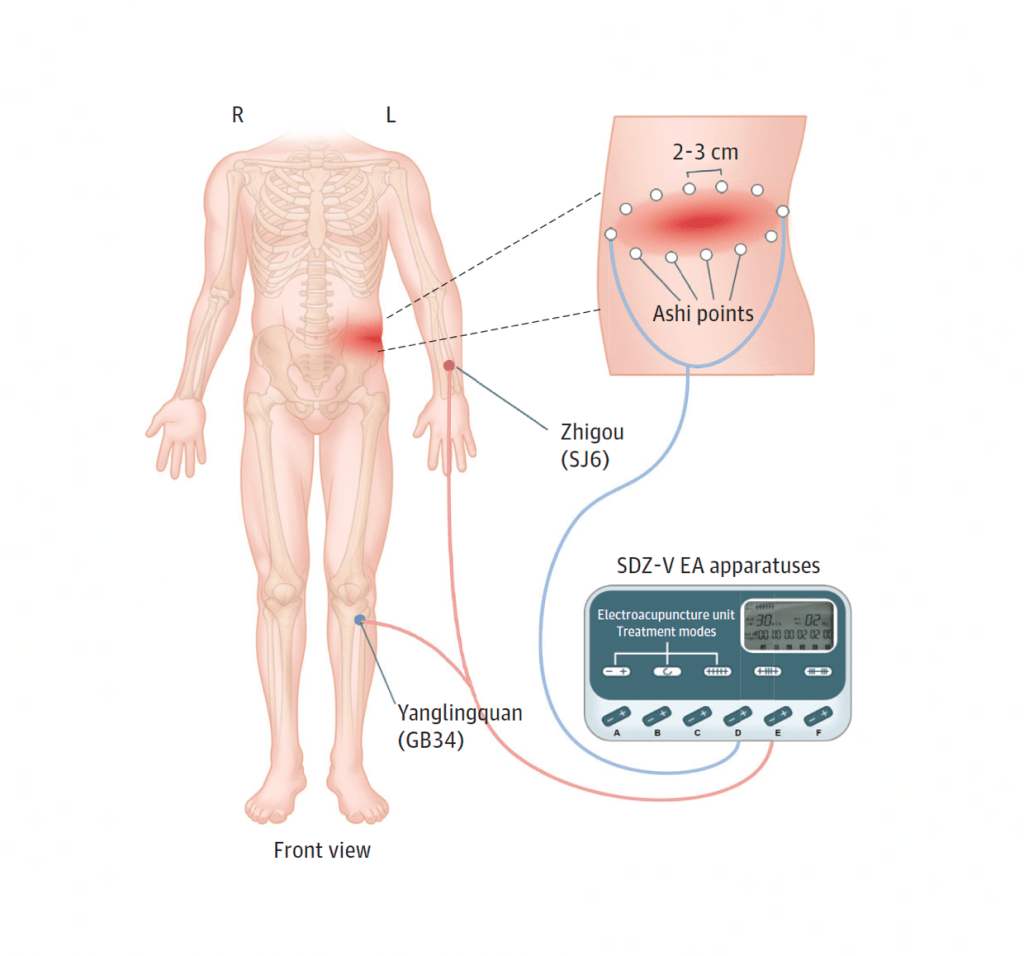
The EA protocol involved needles at GB34 and TE6 on the ipsilateral side connected together. A surrounding technique was also used with needles inserted obliquely and placed 2-3cm apart around the area affected. The needles at each end of the group were attached to apply EA. EA was applied at 2Hz and 1-5mA until there was a mild muscle twitch around the points.
In the sham group, the same points were used, but blunt needles were inserted into adhesive pads, and the EA leads were attached, but no electrical stimulation was applied. The adhesive pads were used in the real EA group as well.
Both groups received 20 sessions over 4 weeks, which corresponds to daily weekday treatment. This would be very hard to replicate in most western healthcare environments.
The primary outcome was the change from baseline in the NRS score at 4 weeks (the end of the treatment phase). The MCID for an NRS score in this condition is 1.5 and the responder rate was calculated based on a 30% reduction in the NRS, which would be considered a moderate clinical improvement. Outcomes were also measured after a further 4 weeks follow-up.
The difference between EA and sham became significant at 2 weeks (10 sessions) and remained so throughout the trial and follow-up. At the primary endpoint the difference was very highly significant statistically, but the mean difference was only 0.5 on the NRS, which is rather small. The change from baseline in the EA group just reached 1.5 at 4 weeks, and the responder rate was 46%. The equivalent figures in the sham group were ~1 and 24%.
The difference widened slightly at 8 weeks with the effect in the EA group being well maintained over this short follow-up.
How does this compare with conventional approaches? That is quite a difficult thing to judge, since there can be population differences, comparator differences, and differences in tolerance to side-effects.
Topical capsaicin (8% patch) came out on top of a recent NMA for the pain intensity outcome.[2] The mean difference over sham (low dose control patch) was 0.9 (converting to the same scale as in the current study). The change from baseline for topical capsaicin is typically 1.5 to 2.0. Second and third were tramadol (100mg) and gabapentin (gastroretentive).
There were other winners when considering different outcomes, such as hydromorphone for sleep (PSQI) and the combination of amitriptyline and pregabalin for overall clinical superiority (measured on patient questionnaires).
Whilst the results of this trial are less than dramatic, they do position EA well amongst other more conventional treatment options if we consider both efficacy and tolerability. The major drawback though is the intensity of the treatment course tested here. My suspicion is that treatment 3 times a week would be no different, but that is still a significant commitment.
References
1 Chen L, Liu Q, Pei L, et al. Effect of Electroacupuncture on Postherpetic Neuralgia: A Randomized Clinical Trial. JAMA Neurol. Published Online First: 26 May 2026. doi: 10.1001/jamaneurol.2026.1443
2 Guo Z, Xia Y, Zhang Z. Efficacy and safety of different medications compared for the treatment of postherpetic neuralgia: a network meta-analysis. Front Pharmacol. 2025;16:1614587. doi: 10.3389/fphar.2025.1614587


You must be logged in to post a comment.