

Stimulated by Yuasa et al 2026.[1]
AE – adverse event
THA – total hip arthroplasty
TKA – total knee arthroplasty
IF – impact factor
IV – intravenous
CLAP – continuous local antibiotic perfusion
CRP – C reactive protein
GT – greater trochanter
RCT – randomised controlled trial– key to acronyms
This is the first AE report implicating acupuncture in a case of infection around a prosthetic hip joint. I never expected to see such a report because of the depth of the metalwork following THA is considerably greater than that following TKA. We have seen infection related to acupuncture in patients who have metalwork in their knees,[2–5] although not all of these were TKAs,[2] and in one case the needling was referred to as dry needling rather than acupuncture, but probably used the same type of needles.[4]
A previous blog with a similar title from 2021 discussed one of the previous reports related to TKA – see Acupuncture and arthroplasty 2021. This blog also lists the prior joint infections I had in my files related to acupuncture, although I have subsequently come across another important report that includes 2 cases of MRSA infection in shoulder joints following acupuncture from the same doctor.[6]
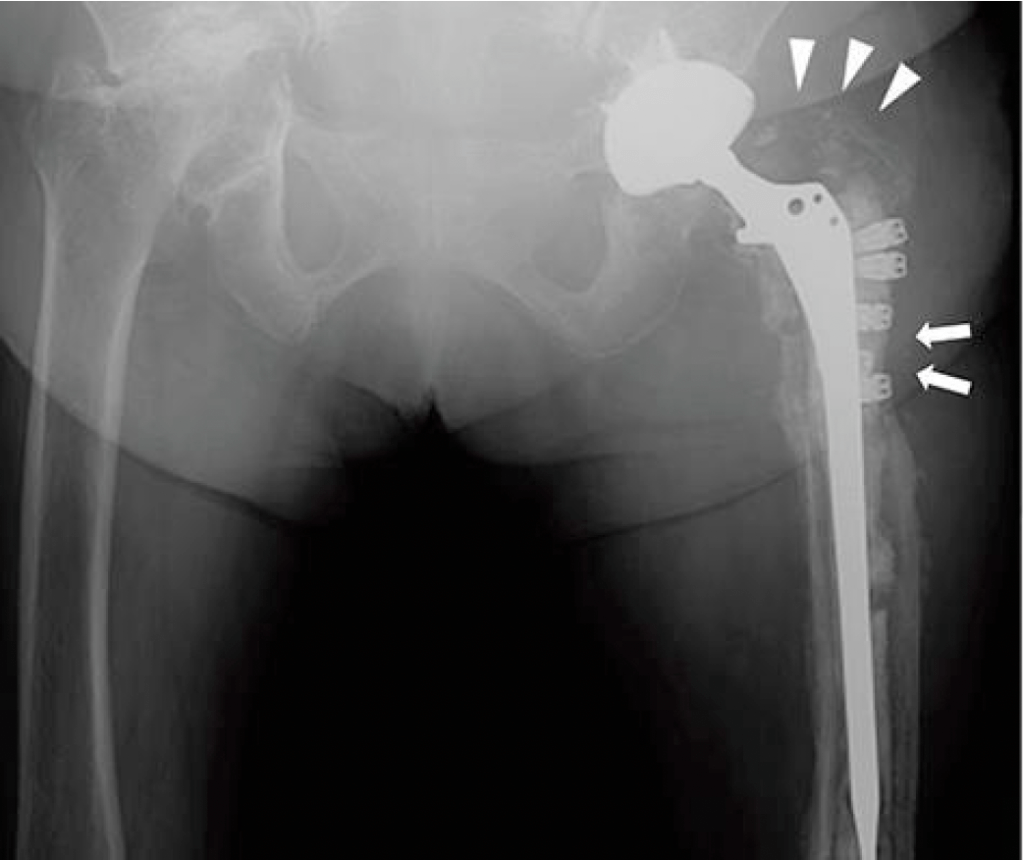
The current report, in the journal Case Reports in Orthopedics (IF 0.6), involved an 81-year-old woman who had undergone THA 4 years prior to presentation. She had unfortunately fallen and sustained a periprosthetic fracture at 5 days post-op, which required revision THA using a prosthesis with a long stem.
She presented with a roughly 3cm diameter purple swelling with a purulent discharge around the middle of the surgical scar related to the prior THAs. She had sought acupuncture for muscle stiffness in the proximal hip the previous month and described needles being inserted down to bone. This treatment was repeated several times and a few days later she noticed redness at the needling sites. She ignored the redness at first, but it gradually worsened.
Ten days of conservative treatment with IV antibiotics was unsuccessful and a sinus track that communicated with the prosthesis was present. Surgical intervention was reluctantly embarked on, but with the caveat that the patient did not want the prosthesis removed. Multiple abscesses were found and they left a catheter with the tip inside the joint in order to perform CLAP therapy (that was new to me).
The patient was able to mobilise with a cane on post-op day 21 and was discharged home. Prolonged oral antibiotics were planned, but the patient discontinued these after about 2 months due to nausea. Her CRP remained elevated, but the patient reported no pain or discharge from the surgical site and was able to perform her normal daily activities.
Whilst I am an advocate of periosteal needling onto the GT (see Periosteal techniques 1963–2018), I never perform such needling in patients who have had THA. One of the key safety principles we teach is to avoid needling directly onto metalwork, or indeed, any foreign material.
An RCT from 2024 is very instructive here (see EA post-TKA 2024). This demonstrated that performing EA on the contralateral (unoperated) knee post-op TKA was just as good in terms of pain relief (and various other outcomes) as ipsilateral EA. I guess the equivalent would be to perform periosteal pecking on the normal GT in a patient with pain following THA, that is if there is still a normal one, since many patients end up with bilateral THA.
References
1 Yuasa A, Kobayashi H, Horiuchi K. Periprosthetic Joint Infection Following Acupuncture Treatment in a Patient With Total Hip Arthroplasty: A Rare but Severe Complication. Case Rep Orthop. 2026;2026:7852835. doi: 10.1155/cro/7852835
2 Laing AJ, Mullett H, Gilmore MFX. Acupuncture-associated arthritis in a joint with an orthopaedic implant. J Infect. 2002;44:43–4. doi: 10.1053/jinf.2001.0911
3 Kruse JP, Lewis RJ, Smith HL, et al. Acupuncture-Associated Mycobacterium goodii Infection of Prosthetic Knee Joint. Infect Dis Clin Pract. 2019;27:e1–2. doi: 10.1097/IPC.0000000000000669
4 Moody PW, Fehring TK, Springer BD. Periarticular needle-based therapies can cause periprosthetic knee infections. Arthroplasty Today. 2020;6:241–5. doi: 10.1016/j.artd.2020.02.006
5 Narayana Murthy S, Srinivasan SH, Archunan M, et al. Prosthetic knee joint infection by an unusual organism following acupuncture treatment. Acupunct Med. 2021;39:571–2. doi: 10.1177/0964528421990661
6 Murray RJ, Pearson JC, Coombs GW, et al. Outbreak of invasive methicillin-resistant Staphylococcus aureus infection associated with acupuncture and joint injection. Infect Control Hosp Epidemiol. 2008;29:859–65. doi: 10.1086/590260


You must be logged in to post a comment.