

Inspired by Hang et al 2026.[1]
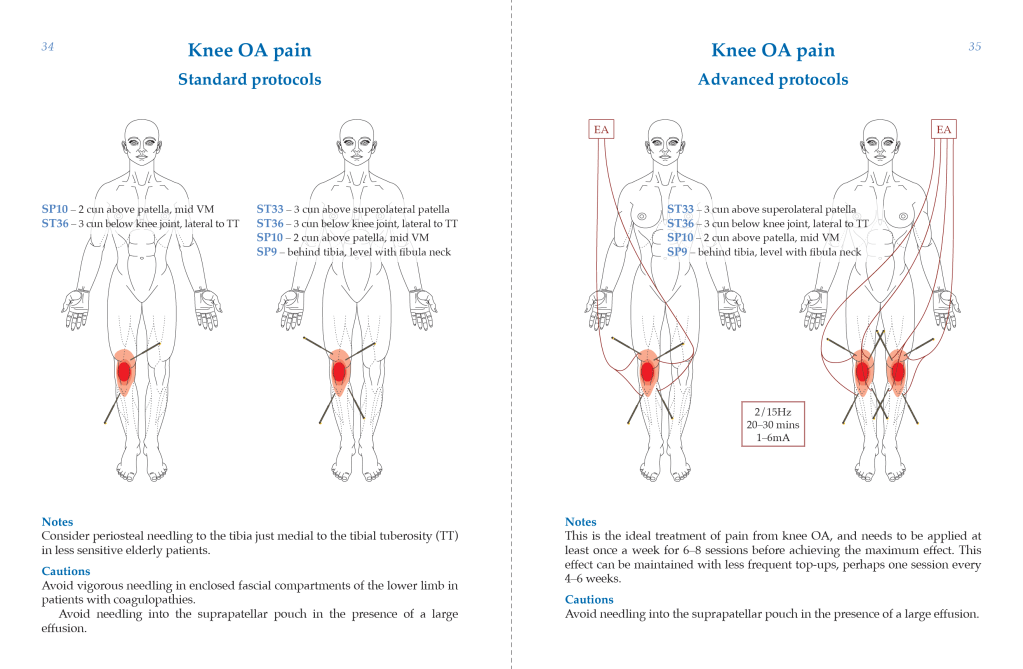
Note that this is not exactly the same protocol used in the trial highlighted.
EA – electroacupuncture
OA – osteoarthritis
OAK – OA of the knee
RCT – randomised controlled trial
MRI – magnetic resonance imaging
MA – manual acupuncture
WOMAC – Western Ontario and McMaster Universities Osteoarthritis Index
VAS – visual analogue scale
MCID – minimum clinically important difference
MCII – minimal clinically important improvement
CI – confidence interval
SMD – standardised mean difference (in this instance a version of Cohen’s d)– key to acronyms
This is a large (n=480) multicentre sham controlled RCT of EA in OAK. It was published earlier this month in the journal eClinicalMedicine (IF 10), which is one of the Lancet Discovery Science journals, is open access, and was first published in 2018. This is only the 5th paper with either acupuncture or electroacupuncture in the title published in this journal.
We have already seen large trials of EA in OAK;[2–4] however, this trial has the largest EA group (n=240), and is the first to use MRI before and after an acupuncture treatment course. Two of the prior large RCTs have been highlighted on here: see Intensive EA/MA in OAK and Strong EA & CPM in OAK. I should also mention that I have highlighted a previous paper on OAK that used MRI before and after 2 years of either 3 monthly steroid or saline injections – see Why not needles for OA – no steroid, just the needles!
There are larger trials using MA,[5,6] but these go back to the Modellvorhaben Akupunktur from the 00s.[7]
This study was based in Shanghai and included 6 clinical research centres. Patients were randomised to EA or a non-penetrating sham EA in a 1:1 ratio. Session were 3 times a week for 6 weeks.
In terms of the EA connections, my guess (it is a shame when you have to guess) is that ST34 was connected to SP10, the ‘eyes of the knee’ (Xiyan) were connected, ST36 was connected to GB34, and SP6 was connected to GB39.
EA was applied at 2Hz for 5 minutes and then at a mixed frequency (‘sparse-dense’) for a further 20 minutes where the lower frequency was again 2Hz.
Adhesive sponge pads were used over the acupuncture points in both groups. They are described in the text of the Supplement as being 0.5cm diameter cylinders; however, the images provided show cubes of indeterminate size in one view, and flat square pads of about 25mm wide in another view.
The primary outcome was the change in WOMAC global score at 6 weeks (end of treatment). WOMAC has 3 domains, all with a different number if items and therefore a different range of scores. The global score includes all 3 – pain (5 items), stiffness (2 items), and physical function (17 items). There are different ways of scoring each item. Originally each item was scored using a 0 to 100mm VAS (0 to 2400 total), but subsequently a Likert scale (0 to 4) was adopted by some (0 to 96 total). In this paper they used a VAS but in centimetres rather than millimetres, so the scores are all one tenth of the original (0 to 240 total). This variety makes it rather tricky to easily compare between studies.
On here you are used to me using the acronym MCID, but in this paper they use the acronym MCII. They are essentially the same thing. The team decided to use a 12% improvement in the WOMAC global score as the MCII. The baseline for the population they recruited was 154, which gives a reduction of 18.5 as the MCII.
At week 6, the EA group had improved by 65 and the sham EA group by 25. So, the mean change from baseline in both groups and the group mean difference all comfortably exceeded the MCII, as did the lower CI for the group mean difference.
The secondary outcomes were all consistent with the changes in the primary outcome. The MRI findings were more variable with just 5 out of 10 measures being significantly better in the EA group. 2 of these indicated the degree of inflammation, and both were significantly improved at 6 weeks in the EA group. The remaining 8 measures were cartilage thickness and volume in each pole of each compartment. Of these, only 3 out of 8 showed a significant difference in the change at 6 weeks. But 6 weeks is rather a short time to expect to see changes in cartilage. The paper I highlighted previously involving 3 monthly steroid injection looked at changes over a 2-year period.
The effect size for the primary outcome in this trial was 1.21 (SMD), which is a large. But it is not the largest effect size we have seen for EA in OAK. Back in 2004, Jorge Vas demonstrated an identical SMD using EA in combination with diclofenac versus non-penetrating sham EA plus diclofenac (n=97).[8] In 2012, Mavrommatis et al managed an astonishing 2.27 using EA plus etoricoxib versus non-penetrating sham EA plus etoricoxib versus etoricoxib alone (n=120).[9]
The current trial is 4 times bigger than these early trials of EA versus non-penetrating sham EA and the change in WOMAC global score in the active EA arm of the trial (-27%) comes in just below the equivalent change in Mavrommatis (-33%) and quite a bit below that in Vas (-50%). We can discuss why that might be tonight.
References
1 Hang M, Shao Y, Lu W, et al. Electroacupuncture for knee osteoarthritis: a multicentre randomised controlled trial assessing symptomatic and structural efficacy. EClinicalMedicine. 2026;96:103982. doi: 10.1016/j.eclinm.2026.103982
2 Berman BM, Lao L, Langenberg P, et al. Effectiveness of Acupuncture as Adjunctive Therapy in Osteoarthritis of the Knee. Ann Intern Med. 2004;141:901. doi: 10.7326/0003-4819-141-12-200412210-00006
3 Lv Z, Shen L, Zhu B, et al. Effects of intensity of electroacupuncture on chronic pain in patients with knee osteoarthritis: a randomized controlled trial. Arthritis Res Ther. 2019;21:120. doi: 10.1186/s13075-019-1899-6
4 Tu J-F, Yang J-W, Shi G-X, et al. Efficacy of Intensive Acupuncture Versus Sham Acupuncture in Knee Osteoarthritis: A Randomized Controlled Trial. Arthritis Rheumatol. 2021;73:448–58. doi: 10.1002/art.41584
5 Witt CM, Jena S, Brinkhaus B, et al. Acupuncture in patients with osteoarthritis of the knee or hip: A randomized, controlled trial with an additional nonrandomized arm. Arthritis Rheum. 2006;54:3485–93. doi: 10.1002/art.22154
6 Scharf H-P, Mansmann U, Streitberger K, et al. Acupuncture and knee osteoarthritis: a three-armed randomized trial. Ann Intern Med. 2006;145:12–20. doi: 10.7326/0003-4819-145-1-200607040-00005
7 Cummings M. Modellvorhaben Akupunktur–a summary of the ART, ARC and GERAC trials. Acupunct Med. 2009;27:26–30. doi: 10.1136/aim.2008.000281
8 Vas J, Méndez C, Perea-Milla E, et al. Acupuncture as a complementary therapy to the pharmacological treatment of osteoarthritis of the knee: randomised controlled trial. BMJ. 2004;329:1216. doi: 10.1136/bmj.38238.601447.3A
9 Mavrommatis CI, Argyra E, Vadalouka A, et al. Acupuncture as an adjunctive therapy to pharmacological treatment in patients with chronic pain due to osteoarthritis of the knee: a 3-armed, randomized, placebo-controlled trial. Pain. 2012;153:1720–6. doi: 10.1016/j.pain.2012.05.005


You must be logged in to post a comment.