

Stimulated by Kwan et al 2026.[1]
axSpA – axial spondyloarthritis
IF – impact factor
RCT – randomised controlled trial
EULAR – European Alliance of Associations for Rheumatology
SI – sacroiliac
NRS – numerical rating scale
BASDAI – Bath ankylosing spondylitis disease activity index
BASFI – Bath functional index
BAS-G – Bath ankylosing spondylitis global score
HAQ – health assessment questionnaire
SF-36 – 36-item short form health survey
ASQoL – ankylosing spondylitis quality of life
TCMCMC – traditional Chinese medicine collaborative model of care
MCID – minimal clinically important difference
EBM – evidence based medicine
GI – gastrointestinal
AE – adverse event– key to acronyms
This is a pragmatic RCT (n=139) from Singapore published in the journal EULAR Rheumatology Open. It is the first time I have highlighted a paper from this journal, which has only been around since the start of 2025, so it does not have an impact factor yet (a journal needs to be around for at least 3 years to get one). Its sister journal is Annals of the Rheumatic Diseases (IF 24), so I am expecting the quality to be good. Both are EULAR journals.
EULAR is the European Alliance of Associations for Rheumatology. It is a non-profit organisation that represents people with rheumatic and musculoskeletal diseases, health professionals in rheumatology, rheumatologists, researchers and scientific societies in the field of rheumatology of all the European nations.
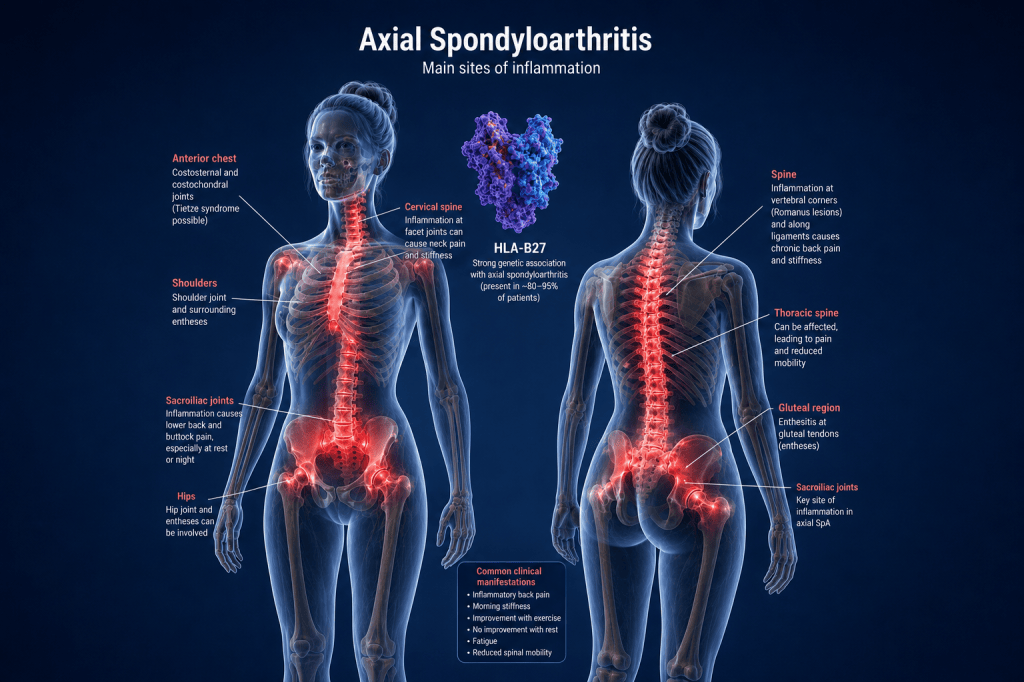
Axial spondyloarthritis (axSpA) is the newish umbrella term that includes ankylosing spondylitis. It emerged in the mid-00s but was formally established in 2009. The term includes both radiographic and non-radiographic disease. AxSpA is a chronic immune-mediated inflammatory disease primarily affecting the SI joints and spine.
It is a single centre RCT of acupuncture added to routine care of patients with axSpA versus routine care alone. This sort of study is sometimes referred to as A+B vs B. In order to qualify for the study the patients had to have active disease with spinal pain of 4 or more on a 0 to 10 NRS (this was also the primary outcome at 6 weeks). They also had to have a BASDAI score of 4 or more (in fact this was the definition of active disease). A further inclusion criterion was that the patients had to have an inadequate response to 2 sequential NSAIDs (including a cyclo-oxygenase 2 inhibitor).
There were 2 other outcomes with Bath in the title – BASFI and BAS-G. In addition to the 3 Bath outcomes, there were the HAQ, SF-36, and ASQoL. In all these scores, apart from the SF-36, higher scores correlated with worse outcomes.
The acupuncture intervention included 10 sessions over 5 weeks and was referred to as TCMCMC (traditional Chinese medicine collaborative model of care). Each session was 30 minutes, and each course of 5 sessions were distributed over 2 weeks separated by 3 to 7 days in-between.
The acupuncture protocol included a set of main points and then additional points based on one of 5 possible TCM diagnostic patterns. The main points were BL23, GV3, GV4, jiaji (paraspinals), and GB30. This comes to 8 needles if only one set of jiaji points were used. The additional points ranged from 2 to 4 bilateral points, making a total of between 12 and 16 needles in total
The mean baseline spinal pain score was 6.3 out of 10. At 6 weeks this had reduced to 4.03 in the acupuncture group and 4.78 in the routine care group. So, the mean change from baseline was over 2 in the acupuncture plus routine care group, which is clearly clinically relevant, but since the routine care group improved by ~1.5, the advantage of adding acupuncture was below what would be considered to be a MCID. Of course, MCIDs have no meaning when applied to group mean differences, but who am I kidding, the EBM crowd have been doing this routinely for years.
For context, naproxen 500mg bd for 12 weeks in patients with axSpA resulted in a reduction of global pain of 3.5 but also serious upper GI AEs occurred in about 2%.[2] Celecoxib wasn’t quite as good, with a global pain reduction of 3, but no serious AEs.
My impression is that we will hear (or more likely see) further reports of outcomes from this highlighted study in due course.
References
1 Kwan YH, Woon TH, Sum CWY, et al. Traditional Chinese Medicine (TCM) collaborative care involving acupuncture for axial spondyloarthritis: 6-week exploratory results of a pragmatic randomised controlled trial. EULAR Rheumatol Open. 2026;2:100166. doi: 10.1016/j.ero.2026.03.014
2 Barkhuizen A, Steinfeld S, Robbins J, et al. Celecoxib is efficacious and well tolerated in treating signs and symptoms of ankylosing spondylitis. J Rheumatol. 2006;33:1805–12.


You must be logged in to post a comment.