

Stimulated by Hao et al 2026.[1]
LDH – lumbar disc herniation
RCT – randomised controlled trial
BUCM – Beijing University of Chinese Medicine
VAS – visual analogue scale
SP – spinous process of the vertebra (the lower border in this case)
DN – deep needling group (needles placed at 1 cun lateral to the SP and 60 to 70mm deep)
CN – conventional needling group
HJ – Huatuojiaji group (refers to the extra points 0.5 cun either side of the SPs)
DLSS – degenerative lumbar spinal stenosis
CT – computer tomography
LBP – low back pain
JOA – Japanese Orthopaedic Association score for low back pain
ODI – Oswestry disability index– key to acronyms
This is a moderately large (n=165) 3-arm RCT from BUCM. It is just out in the journal Pain Research and Management (IF 3.1).
It is quite an unusual trial because it involves real acupuncture in all 3 arms.
It is a single centre trial conducted at the Beijing Hospital of Integrated Traditional Chinese and Western Medicine. That is a name I have not heard before, although it dates back to 1989. This hospital was originally called Beijing Second Sanitorium in 1952, and then Beijing Yongdinglu Hospital in 1959. The hospital became affiliated with BUCM in 2025.
The patients included had LDH with leg pain (VAS 0 to 10) of between 4 and 8, and symptom duration of 8 weeks or less.
The patients were randomised in a 1:1:1 ratio into DN, CN, and HJ groups. My reading of the methods suggests that 5 points were used in each group. One point in the back on the affected side and 4 points in the ipsilateral leg, either GB or BL points, or a combination, depending on the distribution of leg pain.
The DN and CN groups received a point on the back 1 cun lateral to the SP at the relevant level (L4, L5, or S1). In the DN group the needle was placed 60 to 70mm deep until the patient felt a mild transient sensation to the lower limb. This sounds like contact with or proximity to a nerve root. In the CN group, the needle was inserted 20 to 30mm. In the HJ group the needle was inserted to the same depth as in the CN group, but at 0.5 cun from the SP.
We have seen this sort of deep needling in the lumbar spine previously, see Acupuncture for DLSS.[2] This was a multicentre study, also based in Beijing. Another related study from Beijing was on chronic sciatica, but this did not involve deep needling in the lumbar spine, see Acupuncture for chronic sciatica 2024.[3]
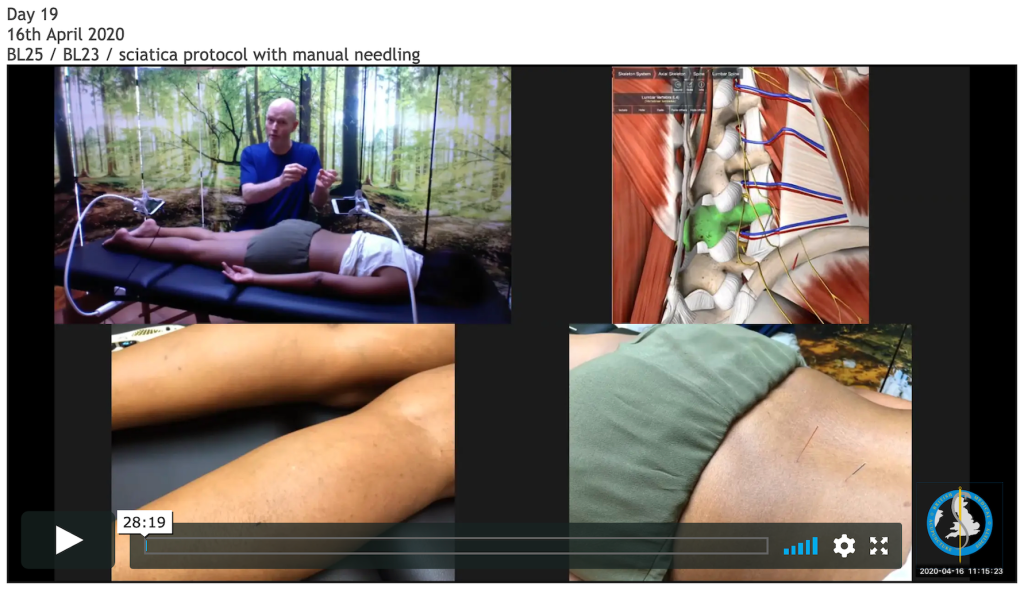
I first came across this sort of deep needling as a result of a small trial published in Pain Medicine in 2019,[4] see Sciatica 2020. I tried out the technique on Day 19 of the What’s the Point series of videos on 16th April 2020. BMAS members can go and see me insert a needle 60mm at BL25 in Deniah’s back. It turned out to be relatively uneventful; however, I have hit a nerve root at 65mm in the past, when I missed a facet joint in a patient some years ago.[5]
In the current trial, the leg points were either GB30, 31, 34, 39, or BL36, 54, 57, 60, or a combination of 4 from both sets. GB30 was needled 50 to 65mm until a mild transient sensation was referred to the lower leg. This sounds like contact with or proximity to the sciatic nerve.
The treatments were applied 3 times a week for 4 weeks, making a total of 12 sessions. The first session was performed in the CT room, and the patients were scanned with the needles in place.
The primary outcome was VAS pain intensity. The paper says LBP, but I guess it should refer to leg pain, since many patients only have leg pain, and VAS leg pain between 4 and 8 was an inclusion criterion.
Secondary outcomes were the JOA and ODI, and assessments were made at baseline, 4 and 12 weeks.
The JOA score for low back pain was introduced in 1986,[6] following a similar score for cervical myelopathy in 1975.[7] Since those original scores, both have been modified more than once.
This trial uses the original version of the JOA score for low back pain, which ranges from 0 to 29, with higher numbers corresponding to better function. Points are allocated to subjective symptoms (9 points), clinical signs (6 points) and activities of daily living (14 points).
The ODI has 10 items including pain and activities related to low back function, each scoring 0 to 5. The total score is 50 if all items are answered and higher scores are associated with poorer function.
All three groups improved from baseline to a clinically relevant degree, but the DN group appeared to be significantly better than the other two groups. JOA and ODI also improved (JOA increased and ODI decreased).
There appeared to be some differences in JOA and ODI at baseline, but changes were analysed using ANCOVA, which adjusts for this.
In the DN group, the mean insertion depth of the lumbar needle was 59.1mm (SD 6.7mm).
References
1 Hao W, Liang-Hua Z, Wei C, et al. Efficacy and Safety of CT-Verified Deep Needling at the Foramen Acupoint for Lumbar Disc Herniation: A Randomized Controlled Trial. Pain Res Manag. 2026;2026:e9030734. doi: 10.1155/prm/9030734
2 Zhu L, Sun Y, Kang J, et al. Effect of Acupuncture on Neurogenic Claudication Among Patients With Degenerative Lumbar Spinal Stenosis : A Randomized Clinical Trial. Ann Intern Med. 2024;177:1048–57. doi: 10.7326/M23-2749
3 Tu J-F, Shi G-X, Yan S-Y, et al. Acupuncture vs Sham Acupuncture for Chronic Sciatica From Herniated Disk: A Randomized Clinical Trial. JAMA Intern Med. 2024;184:1417–24. doi: 10.1001/jamainternmed.2024.5463
4 Huang Z, Liu S, Zhou J, et al. Efficacy and Safety of Acupuncture for Chronic Discogenic Sciatica, a Randomized Controlled Sham Acupuncture Trial. Pain Med. 2019;20:2303–10. doi: 10.1093/pm/pnz167
5 Cummings M. Acupuncture for low back pain in pregnancy. Acupunct Med. 2003;21:42–6.
6 Fukui M, Chiba K, Kawakami M, et al. Japanese Orthopaedic Association Back Pain Evaluation Questionnaire. Part 2. Verification of its reliability : The Subcommittee on Low Back Pain and Cervical Myelopathy Evaluation of the Clinical Outcome Committee of the Japanese Orthopaedic Association. J Orthop Sci. 2007;12:526–32. doi: 10.1007/s00776-007-1168-4
7 Kato S, Oshima Y, Oka H, et al. Comparison of the Japanese Orthopaedic Association (JOA) score and modified JOA (mJOA) score for the assessment of cervical myelopathy: a multicenter observational study. PloS One. 2015;10:e0123022. doi: 10.1371/journal.pone.0123022


You must be logged in to post a comment.