

Stimulated by Liu et al 2026.[1]
GBS – Guillain-Barré syndrome
IF – impact factor
SR – systematic review
AIDP – acute inflammatory demyelinating polyradiculoneuropathy
AMAN – acute motor axonal neuropathy
AMSAN – acute motor sensory axonal neuropathy
IVIg – intravenous immunoglobulin
HFGS – Hughes functional grading scale
MRC-SS – Medical Research Council sum score for global limb muscle strength
PSM – propensity score matching– key to acronyms
This is a prospective cohort study from China published in the journal Frontiers in Neurology (IF 3.3). It is the first time that GBS has appeared on this blog, and it is only the 4th paper on PubMed with both Guillain-Barré syndrome and acupuncture in the title. The others are case reports and a protocol for an SR.[3–5] The latter suggests that there could be some prospective trials published in the Chinese literature that are not listed on PubMed.
GBS is the most common cause of acute flaccid paralysis with a global incidence of 1-2 per 100 000 person-years.[6] The classical picture is of an acute-onset ascending sensorimotor polyradiculoneuropathy, but there are a number of variants within a spectrum of disease for which the presentation can be clinically heterogeneous. Common subtypes, in order of frequency, have the acronyms AIDP (85-90%), AMAN (5-10%), and AMSAN (2-5%). A cranial nerve variant is called Miller Fisher syndrome and a version with reduced consciousness is called Bickerstaff brainstem encephalitis.[6]
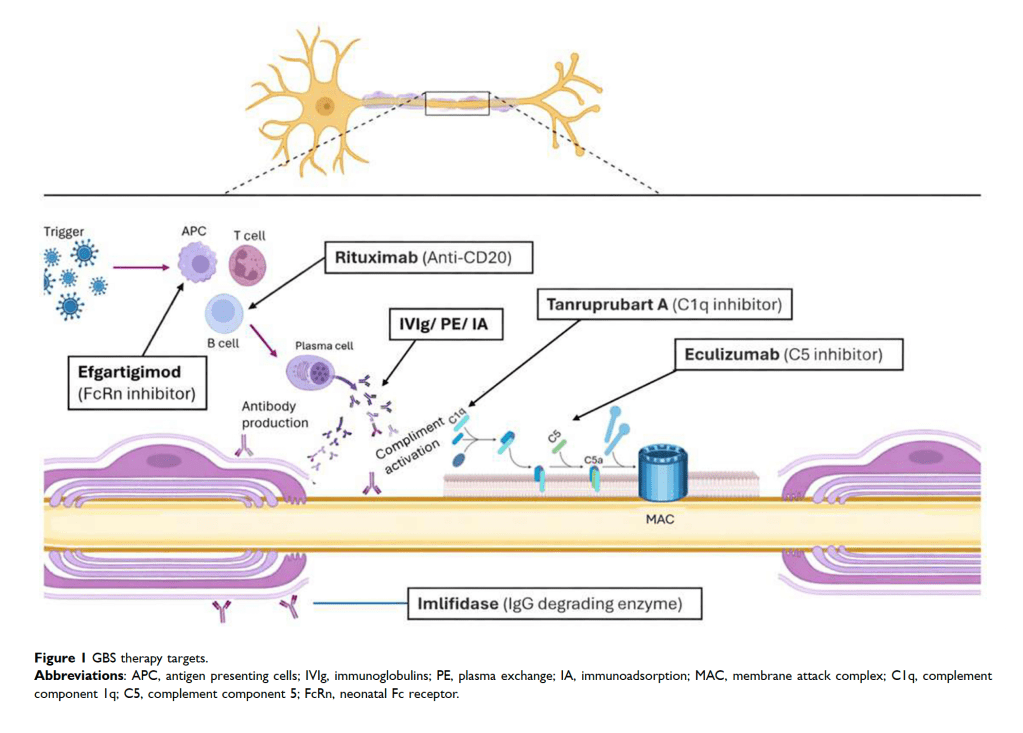
The pathophysiology is of an aberrant immune response targeting gangliosides on neural cell membranes. It is likely to be a cross-reaction triggered by an immune response to infection where the infecting organism expresses ganglioside-like molecules on its surface. The most common organism implicated is Campylobacter jejuni, which expresses a sialylated lipo-oligosaccharide on its surface with structural similarity to the gangliosides GM1 and GQ1b. It is estimated that roughly 1 in 1000 people with develop GBS following an infection with C jejuni.[2]
Gangliosides are named based on where they were discovered but they are ubiquitous in neural membranes and not restricted to ganglion cell bodies. They are glycosphingolipids that contain one or more molecules of sialic acid (usually N-acetylneuraminic acid).
The highlighted study comes from a single centre in Wuhan, China. Patients with GBS (n=128) were enrolled over a 1-year period and stratified into acupuncture and control groups based on the treatment they received. My impression is that all patients with GBS in this centre are offered acupuncture alongside conventional treatment, but a certain number decline the acupuncture. In this prospective cohort, 58 received acupuncture and 70 received conventional treatment only. The latter includes supportive care plus IVIg and plasma exchange.
MA sessions lasted 30 minutes and included LI4, LI11, ST36, GB34, Jiaji (EX-B2), and GV14. Manual stimulation was performed and some degree of individualisation was allowed based on symptoms. We are not told how often the sessions occurred, but my guess would be 3 to 5 times a week since the patients were in hospital throughout the study period of 2 weeks.
Outcomes were the HFGS and the MRC-SS. The HFGS is a simple 7-point scale of clinical performance from 0 (normal) to 6 (death).
HFGS
0 – Normal
1 – Slight clinical symptoms and signs
2 – Able to walk 5m without assistance, but unable to run
3 – Able to walk 5m with help
4 – Bedridden or chair-bound
5 – Ventilator-assisted breathing
6 – Death
MRC-SS uses a 6-point grading of muscle power applied to 3 movements of upper and lower limbs giving a total score from 0 to 60.
0 – No visible contraction
1 – Flicker or trace contraction
2 – Active movement with gravity eliminated
3 – Active movement against gravity
4 – Active movement against resistance (less than normal)
5 – Normal power
A 1-point or greater improvement in the HFGS and a 6-point or greater improvement in the MRC-SS were taken as clinically relevant changes. The primary endpoint was taken as 2 weeks after admission.
At 2 weeks, 53% of patients in the acupuncture group had a HFGS improvement of 1 or more compared with 36% in the control group. The MRC-SS outcome showed a similar result with 57% and 37% respectively.
These appear to be worthwhile benefits associated with the addition of acupuncture to the conventional care of patients presenting with GBS, and broadly speaking, the established anti-inflammatory and neuroprotective effects of acupuncture would be consistent with a causal relationship. However, there was no attempt to match the cohorts (using PSM) and no discussion of blinded assessment for the main outcomes. The latter would have been relatively straightforward to achieve. We are left wondering about the potential for residual confounding of the measured association between improved outcomes and the addition of acupuncture.
Having said that, this is the first paper of its kind that I have seen in GBS and it certainly lays the path well for further prospective research designed to test the efficacy question.
References
1 Liu S, Lu H, Kang Y, et al. Acupuncture is independently associated with improved recovery in Guillain-Barré syndrome: a prospective observational study. Front Neurol. 2026;17:1855894. doi: 10.3389/fneur.2026.1855894
2 Freiha J, Min YG, Osman C, et al. Guillain-Barré Syndrome: Progress in Diagnosis, Biomarkers, Neuroimaging and Management. ImmunoTargets Ther. 2026;15:390161. doi: 10.2147/ITT.S390161
3 Li J, Xu D, Liu Y, et al. Acupuncture Treatment of Guillain-Barré Syndrome After Using Immune Checkpoint Inhibitors: A Case Report. Front Neurol. 2022;13:908282. doi: 10.3389/fneur.2022.908282
4 Lee HJ, Park IS, Lee J-I, et al. Guillain-Barré syndrome following bee venom acupuncture. Intern Med. 2015;54:975–8. doi: 10.2169/internalmedicine.54.2238
5 Fan Z, Liu B, Zhang Y, et al. The effectiveness and safety of acupuncture therapy for Guillain-Barré syndrome: A systematic review and meta-analysis protocol. Medicine (Baltimore). 2020;99:e18619. doi: 10.1097/MD.0000000000018619
6 Leonhard SE, Mandarakas MR, Gondim FAA, et al. Diagnosis and management of Guillain-Barré syndrome in ten steps. Nat Rev Neurol. 2019;15:671–83. doi: 10.1038/s41582-019-0250-9
 The BMAS Blog
You must be logged in to post a comment.