

Stimulated by Jyung et al 2026.[1]
EA – electroacupuncture
PEACE – Personalised EA vs AA Comparative Effectiveness
MSKCC – Memorial Sloan Kettering Cancer Center
AA – auricular acupuncture (BFA here)
BFA – battlefield acupuncture
UC – usual care
MSK – musculoskeletal
BPI – brief pain inventory
PCS – pain catastrophising scale
PC – pain catastrophising– key to acronyms
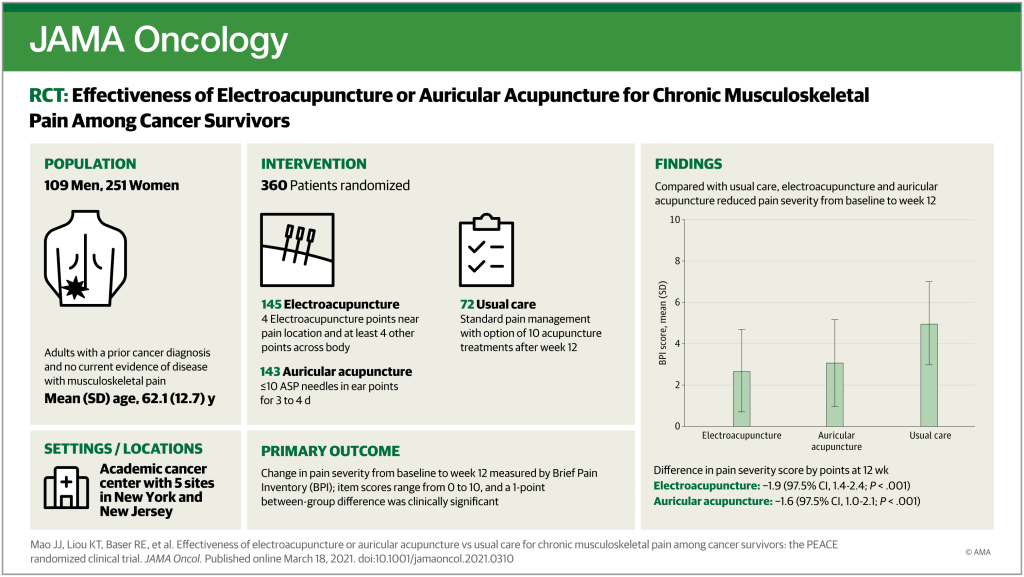
This is a secondary analysis of the PEACE trial (n=266), which was based at MSKCC and I highlighted on this blog in 2021, see EA or AA vs UC – the PEACE trial.[2] The population was cancer survivors suffering from chronic MSK pain. It is just out in the Journal of Pain and Symptom Management (IF 4), which sits in the palliative care sector.
In the previous blog I detailed the different interventions (EA vs BFA vs UC) and the main outcome (BPI). This secondary analysis includes patients from the 2 acupuncture intervention arms who also had both baseline PCS and pain data as well as 12-week outcome data. Whilst the original trial had 360 patients, this secondary analysis had 266 patients, 133 in each of the acupuncture arms, and none from the UC arm (72 in the original trial).
The PCS is a 13 item self-reported questionnaire with each item being scored from 0 to 4. The maximum score is 52 and a score of 30 or more was used to define the high PC group. The questions on the PCS concern helplessness (6 items), magnification (3 items), and rumination (4 items).
A relatively small group (n=41, 15%) scored 30 or more on the PCS. Unsurprisingly, this group had higher baseline pain scores than the rest (6.3 vs 4.8). This gave the high PCS group an advantage over the low PCS group in terms of the size of the change in average pain, since the change in pain scores with any treatment is likely to be greater with higher baseline pain.
Interestingly, there was a much bigger and very highly significant change in average pain in the high PCS group who received EA (-3.9) compared with the low PCS group who received EA (-2.1). This was not the case for those who received BFA (-2.5 vs -1.9 respectively).
Pain interference followed a similar pattern, but not to the same extent and the difference in the EA groups just reached significance.
Responders were defined as a reduction in pain of more than 30% from baseline. In the high PCS EA group, there was an astonishing 83.3% response rate compared with 43.5% in the high PCS BFA group. In the low PCS group the response rates were similar (EA 66.1%, BFA 64.5%).
That all seems pretty clear cut to the casual reader; however, from a methodological perspective we need to be really careful how we interpret these results. It is a secondary analysis, the high PCS group is rather small, there is no adjustment for multiple probability testing, and there is no adjustment for baseline differences in pain between the groups that are compared. Also, there was no actual statistical test that compared the pain reduction from EA with that from BFA in the high PCS subgroup.
We are presented with enough data to do the maths ourselves (specifically the CIs of the average pain reduction), and unfortunately, we cannot say that EA is significantly better than BFA in the high PCS subgroup, nor indeed in the rest (low PCS group).
I should repeat my comment from the previous blog that EA was significantly better than BFA in the original trial, although this was not specifically stated in the paper.
So, what are we left with? Well, we can certainly hypothesise that EA does not seem to be at a disadvantage in patients with high PC, which does not appear to be the case for most other pain treatments.
References
1 Jyung H, Sun L, Li Q, et al. The effect of pain catastrophizing on acupuncture treatment for chronic pain in cancer survivors. J Pain Symptom Manage. 2026;S0885-3924(26)00830-4. doi: 10.1016/j.jpainsymman.2026.06.008
2 Mao JJ, Liou KT, Baser RE, et al. Effectiveness of Electroacupuncture or Auricular Acupuncture vs Usual Care for Chronic Musculoskeletal Pain Among Cancer Survivors: The PEACE Randomized Clinical Trial. JAMA Oncol. 2021;7:720–7. doi: 10.1001/jamaoncol.2021.0310


You must be logged in to post a comment.