

Inspired by Bitencourt et al 2026.[1]
IF – impact factor
ICMART – International Council for Medical Acupuncture and Related Techniques
FMD – flow mediated dilation
pSBP – peripheral systolic blood pressure
NO – nitrous oxide
pDBP – peripheral diastolic blood pressure
MA – manual acupuncture– key to acronyms
I remember seeing this paper come up on my searches earlier this year. I did not shortlist it at the time because it was rather small (n=30). I am highlighting it now because I met the lead author (Dra Amanda Rodrigues Bitencourt) at the ICMART conference in Istanbul this weekend and I was able to ask her more about the details of this study that won her the ICMART Science Award. It was published in Arquivos Brasileiros De Cardiologia (IF 2.3), which is the journal of the Brazilian Cardiology Society aka the SBC (Sociedade Brasileira de Cardiologia).
The research team are based in a place called Goiânia, which is the capital of the Brazilian state of Goiás in central Brazil, approximately 200km southwest of Brasília. I learned that their unit is currently the only one in the whole of Brazil that has the equipment to measure FMD, which was one of the secondary outcomes of the trial.
I had not previously heard of this outcome, which was another reason for selecting this paper to highlight. FMD is a measure of endothelial function, and this was assessed using the UNEX EF38G high-resolution ultrasound system, which is apparently the reference standard for measuring FMD. A picture of the device is included in the study protocol, which was published as a research letter in the same journal last year.[2] It incorporates a robotic arm that automatically scans the brachial artery with high precision and reproducibility. A pneumatic cuff positioned distal to the antecubital fossa is inflated to 50 mmHg above the subject’s pSBP for 5 minutes. The longitudinal diameter of the brachial artery is continuously recorded by ultrasound for 60 seconds immediately before cuff inflation and for 2 minutes after cuff deflation. FMD is calculated as a percentage change in arterial diameter.
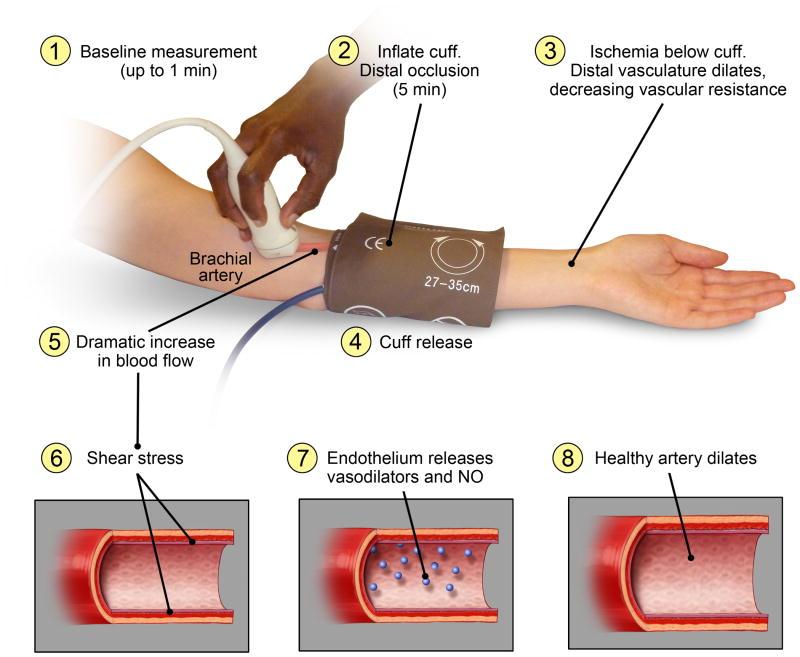
I asked Amanda if the test was painful and she just shrugged and said that it was tolerated well. After 5 minutes of ischaemia distal to the cuff, blood flow to the distal arm is much increased when the cuff is deflated and the increased flow in the brachial artery creates a shear stress in the endothelium resulting in the release of NO and subsequent arterial dilation.
The population for the trial were described as prehypertensive with low cardiovascular risk and not on any antihypertensive drugs. They were eligible for the trial if their pSBP as 130 to 159 or their pDBP was 85 to 99.
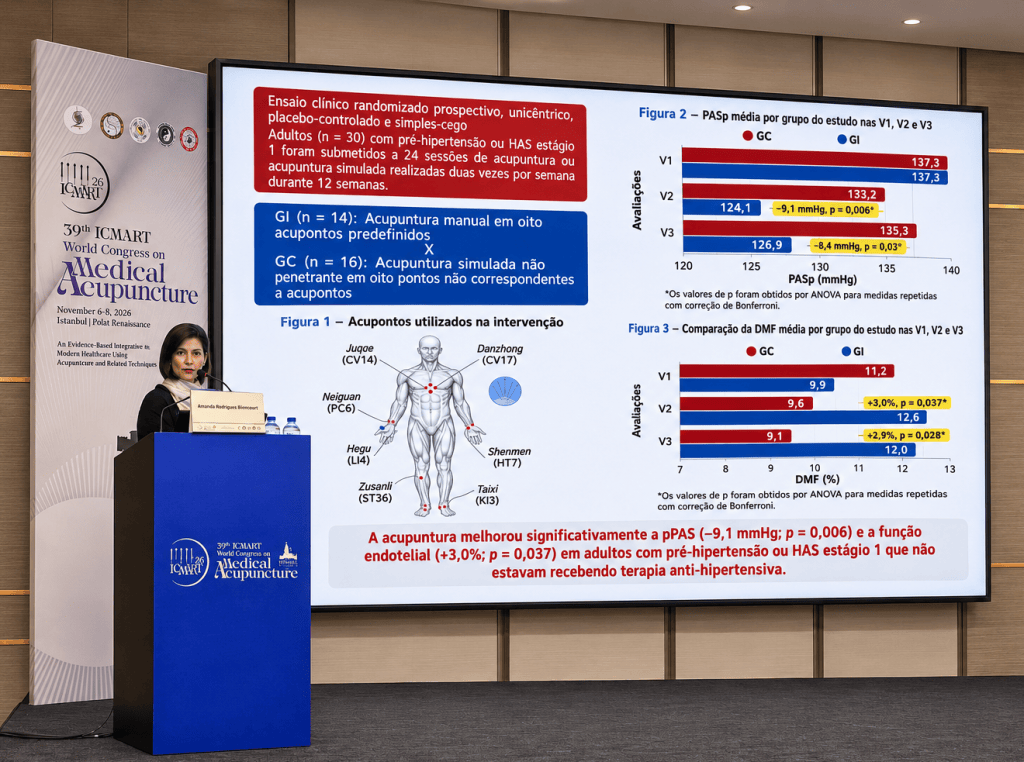
Patients were randomised to either MA or a non-penetrating sham using the Streitberger device and needle at 8 points that were not classical acupuncture points. The points used in the MA group were PC6, HT7, LI4, CV17, CV14, ST36, LR3, KI3. Limb points were needled unilaterally making a total of 8 needles. The side needled was randomly selected at each session. 24 sessions of 30 minutes were performed over 12 weeks.
Outcomes were measured at baseline, following the 12-week treatment course and again at a 30 day follow-up. The primary outcome was mean pSBP compared between the groups after the treatment phase. The secondary outcomes included a number of other BP measures along with FMD.
The mean pSBP dropped from 137 mmHg to 124 mmHg in the MA group and from 137 mmHg to 133 mmHg in the sham group. The mean difference between groups at the end of treatment was 9.1 mmHg and at 30 days following the end of treatment was 8.4 mmHg. These seem like rather big differences to me, but it was 24 treatment sessions and penetrating versus non-penetrating needling.
The FMD changes were also significant with a difference of 3% between group means. The MA group went from a baseline of 9.9% to 12.6% after the treatment course. The sham group started at 11.2% and reduced to 9.6%. Mean FMD in healthy subjects is around 6%, so the values in this study are rather hard to interpret since they start in or above the high end of the normal range. FMD is lower in men than women, reduces with age and reduces in cardiovascular disease.
So, this looks like a good result for pSBP in an overweight population with modestly raised BP who are as yet untreated. We need to be cautious due to the small numbers and the unblinded assessment. The use of FMD is novel in the acupuncture literature and I am grateful for meeting Dra Amanda and learning about it at the ICMART conference in Istanbul, although the actual results in this small trial are difficult to interpret.
I will tell you all the latest international acupuncture gossip at the webinar tonight.
References
1 Bitencourt AR, Sousa ALL, Veiga Jardim PCB, et al. Effects of Acupuncture on Arterial Hypertension and Endothelial Dysfunction: The AHEaD Trial. Arq Bras Cardiol. 2026;123:e20260462. doi: 10.36660/abc.20260462i
2 Bitencourt AR, Sousa ALL, Vitorino PV de O, et al. Acupuncture for Essential Hypertension and Endothelial Dysfunction: A Randomized Clinical Trial. Arq Bras Cardiol. 2025;122:e20240596. doi: 10.36660/abc.20240596


You must be logged in to post a comment.