

Inspired by Usichenko et al 2026.[1]
TEE – transoesophageal echocardiography
IF – impact factor
WFAS – World Federation of Acupuncture Societies
ATCM – Association of Traditional Chinese Medicine (UK)
VRS – verbal rating scale
IQR – interquartile range– key to acronyms
This trial is hot off the (virtual) press in the journal Clinical Research in Cardiology (IF 3.4), which is the official journal of the German Cardiac Society, known by the acronym DKG (Deutsche Gesellschaft für Kardiologie). The lead author (Taras Usichenko) should be familiar to BMAS members as he has regularly spoken at BMAS meetings over the last decade or two and often brought entertainment with him. The latter was often Ukrainian vodka and Russian caviar for MC, but he would also sometimes surprise us with demonstrations on colleagues.
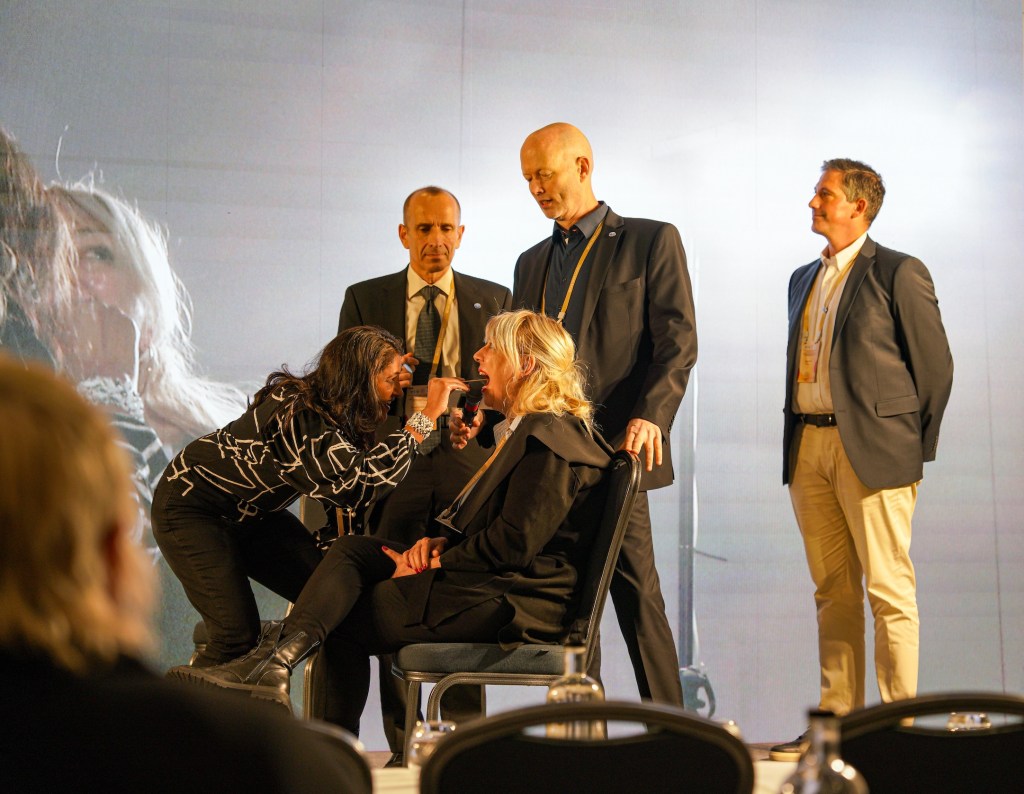
The image above was taken by one of the official photographers at the WFAS 2024 meeting co-hosted by the ATCM and BMAS in London. It was during the BMAS symposium held during the conference. Taras presented this study and demonstrated one of the key points used to inhibit the gag reflex during TEE.
Interestingly, the ladies turned out to be better subjects during this experiment, where a tongue depressor was used instead of a TEE device. Taras simply measured how far the tongue depressor could be inserted in the same subject before and after stimulation of the acupuncture point CV24, which is in the midline just above the prominence of the chin in the centre of the mentolabial groove.
I cannot remember exactly how many millimetres of insertion were gained during this procedure, but it seemed to be a convincing demonstration. Of course, insertion of a TEE device into the oesophagus is likely to be considerably more stimulating of the gag reflex.
In the actual study (n=60), patients scheduled for elective ambulatory TEE were randomised to either acupuncture or sham. In the real acupuncture group, ‘New Pyonex’ needles (0.20 x 1.5mm) were placed at PC6 bilaterally and a ‘Spinex’ needle (0.14 x 6mm) was placed at CV24 and covered with a New Pyonex placebo device, which lacks any needle. There are some useful images of these needles and procedures in the published protocol.[2]
In the sham group, New Pyonex placebo devices were used for all the points, but before placement of these, the practitioner examined the area of the points with a ‘SVESA neural pen’ (Neuralstift SVESA), which can give a pricking sensation when applied firmly to the point.
The primary outcome was the intensity of gagging rated by the patient on the 11-point VRS, where 0 = no gagging to 10 = maximally uncomfortable under gagging. Secondary outcomes included the requirement for midazolam or propofol as rescue medication as well as the incidence of gagging, nausea, and vomiting. The practitioner performing the TEE also assessed the gagging response on the VRS. There were a number of other metrics measured such as heart rate and oxygen saturation.
The median gagging intensity as rated by the patients was 4 (IQR 2 to 8) in the acupuncture group and 7 (IQR 5 to 8) in the sham group (p=0.13). Use of midazolam was 6 of 30 (20%) in the acupuncture group and 14 of 30 (47%) in the sham group (p=0.03). Blinding was assessed and turned out to be also perfect in both patients and TEE practitioners.
So, this was not a clearly positive trial, but it suggests that there may be a possibility of reducing the requirement for sedation during such procedures, which might well be useful in terms of through put, bed-occupancy, and general efficiency in busy day case departments where such procedures are performed. Clearly, bigger trials are needed of course, but the protocol is simple and scalable, so would suit conveyor belt medicine in large populations.
References
1 Usichenko TI, Müller-Kozarez I, Busch R, et al. Acupuncture for relief of gagging in patients undergoing transoesophageal echocardiography-a randomised placebo-controlled trial. Clin Res Cardiol. Published Online First: 2 November 2026. doi: 10.1007/s00392-026-03048-5
2 Usichenko TI, Müller-Kozarez I, Knigge S, et al. Acupuncture for Relief of Gag Reflex in Patients Undergoing Transoesophageal Echocardiography-A Protocol for a Randomized Placebo-Controlled Trial. Medicines. 2020;7:17. doi: 10.3390/medicines7040017


You must be logged in to post a comment.